Focus on MUW

A young boy sitting at a desk with sheets of paper visible on it. In the background, behind him, there are windows.
During the third stage of 16th Janina Fetlińska Nursing Olympiad, our university will be represented by Piotr Adamczyk, a third-year nursing student. We'll be rooting for him on May 19!
 A group of women and men pose for a group photo in a conference room. Some of the women and men are seated on chairs in the front row, while others stand behind them. Everyone wears name badges on lanyards, and the people seated in the front row hold cameras in their hands or rest their hands on their laps. In the background, there is a screen displaying the text “Conference Together for Health” and a banner of the Students’ Scientific Society.
Developing professional skills and fostering interprofessional collaboration are among the most pressing challenges in modern medical education. Recognizing the importance of effective teamwork in healthcare settings for the quality of patient care and safety, the conference titled “Together for Health” was organized. The event provided a space for integrating students from various medical fields, expanding knowledge about the competencies and roles of different healthcare professions, and developing interprofessional collaboration and effective communication skills.
A young woman is smiling at the camera. She is sitting on a bench. In the background, a building with tall windows can be seen.
It used to be said that "the eyes are the window to the soul", but modern medicine proves that they also show what is happening inside our body. Thanks to modern non-invasive technologies, it is possible to visualize how the retinal arteries change under the influence of physical exertion, investigate the phenomenon of myogenic self-regulation and relate it to other organs and systems in the human body, especially to the cardiovascular system – wrote Maria Żmijewska, a medical student at the Faculty of Medicine of the Medical University of Warsaw.

A person standing against a green exhibition backdrop and holding an award statuette in their hands; in the background, various statuettes are visible along with the inscription “Nagroda Zaufania Złoty Otis” and a graphic timeline marked with specific years.
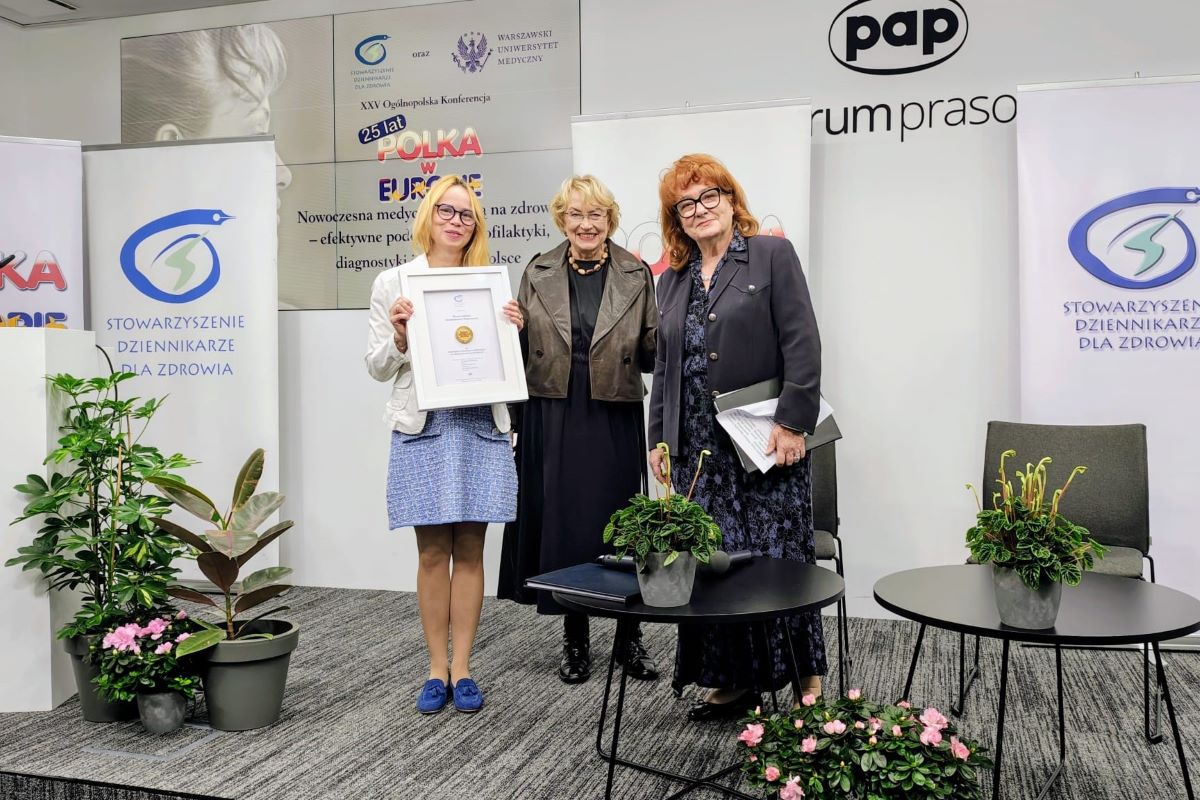
The 23rd Golden OTIS Trust Award Gala has taken place. Among this year’s laureates was Prof. Maria Pokorska-Śpiewak from the Department of Childhood Infectious Diseases at the Medical University of Warsaw.
The lecturer stands at the lectern in an auditorium and addresses the audience; in the foreground, a monitor displaying a presentation is visible, while in the background there are rows of wooden benches with participants.
"The microbiome, which is found in the intestines, constitutes 20–50% of the cells of the human body. This is about 10 billion cells in one gram of colorectal content," said Jakub Piwowarski, the Head of the Microbiota Lab and the Department of Pharmaceutical Microbiology and Bioanalysis at the Medical University of Warsaw, during a lecture for high school students.
A person standing indoors and giving a presentation, wearing a light blue shirt and glasses, holding a presentation clicker in one hand and gesturing with the other, with vertical blinds and an emergency exit sign in the background.
Professor Derewenda is a structural biologist from the University of Virginia (USA). On the occasion of the 100th anniversary of the Faculty of Pharmacy, he visited our university to meet with employees and students and tell them about the history of insulin research and its importance for the development of science and medicine.
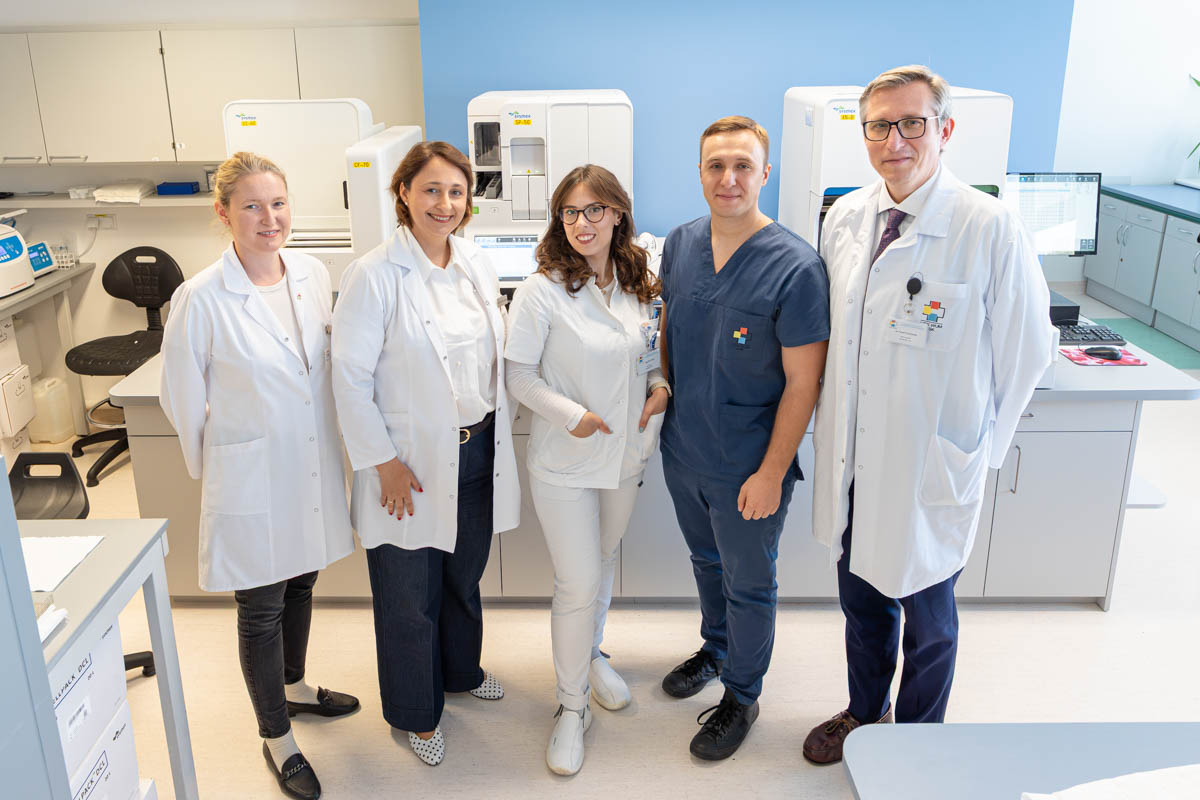
One person is standing in a diagnostic laboratory and looking toward the camera. They are wearing a white laboratory coat. Behind them, modern medical analyzers are arranged in a row. The devices are placed behind a glass enclosure, and the space is brightly and sterily lit.
The Committee, which is part of the European Federation of Clinical Chemistry and Laboratory Medicine (EFLM), is responsible for key areas related to the development and recognition of the profession of laboratory medicine specialist in Europe. The election of Professor Ciepiela, who is currently the Head of the Department of Laboratory Medicine WUM, means not only strengthening the presence of Poland in European structures, but also a real impact on the certification process and the recognition of representatives of this profession.
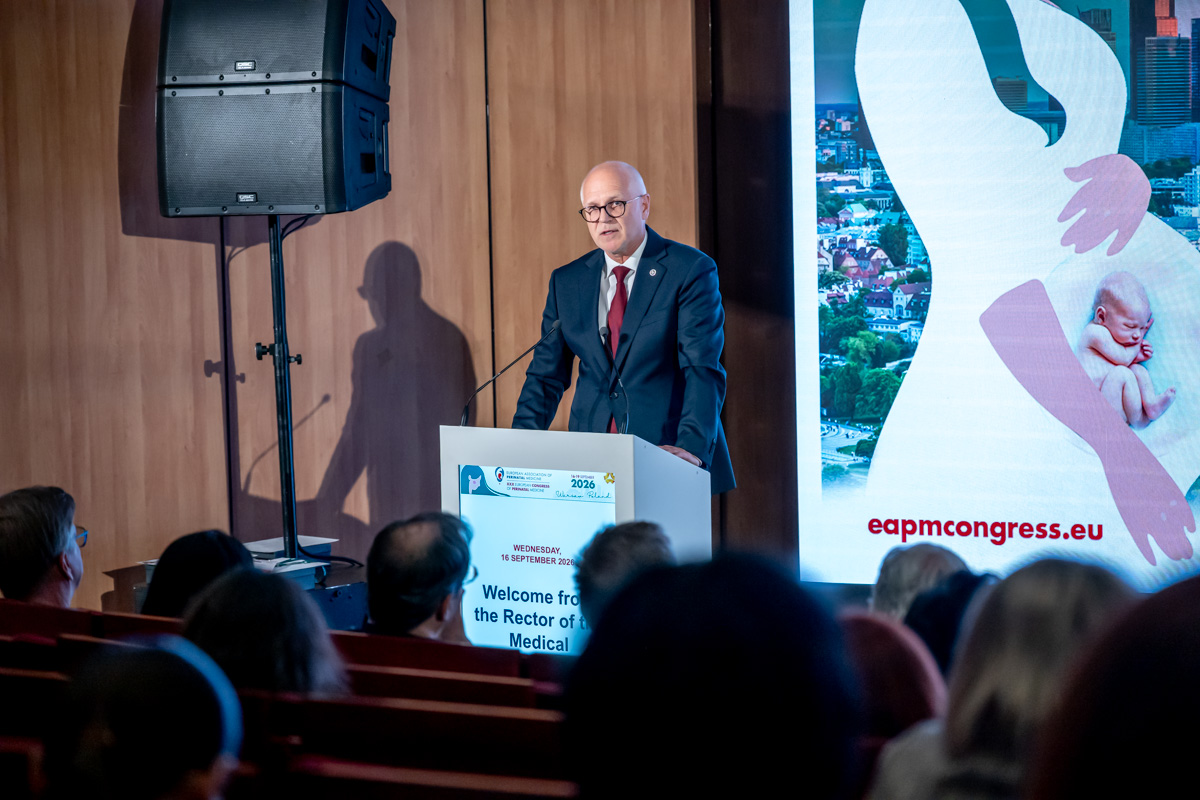
A conference hall during a scientific event. On the stage, a speaker is standing at a lectern, and another person is seated at the presidium table. Behind them, a presentation is displayed with a title concerning central venous cannulation in critically ill patients. The audience is in the foreground, and the stage is illuminated with blue light.
Guidelines of the Polish Society of Anesthesiology and Intensive Therapy titled “Central venous cannulation in critically ill patients” have just been published. Dr. hab. Mateusz Zawadka, who served as chair of the working group, and Dr. Julia Trzebicka participated in the preparation of the document. Both are affiliated with the Second Department of Anesthesiology and Intensive Care at the UCK WUM.
A panel-based Oxford-style debate is taking place in a conference hall. Around a dozen people are seated in a semicircle on the stage, with tables holding water in front of them. In the background, a screen displays the text “Dietetics. Oxford Debate,” and part of the audience is visible in the foreground.
The future of the profession of a dietitian in Poland requires the development of a single, common standard of education – that was the motion of the Oxford-style debate held at our university. The arguments were presented by experts from WUM and invited guests from the Warsaw University of Life Sciences (SGGW). However, it should be emphasized that the dispute was only related to the convention of the debate itself. Its participants had to assume their roles (supporters or opponents), but in fact they were all on the same side.
A young girl wearing glasses is sitting on a bench in a park and looking at the screen of an open laptop.
They were awarded to students participating in the course “Fundamentals of negotiation and conflict resolution,” conducted as part of the Universities of the Future project. The microcredentials were issued by the WUM Teaching Projects Department, which joined the pilot program of the Educational Research Institute – National Research Institute. The program aims to develop a comprehensive microcredential system for higher education institutions in Poland.