What is the goal of the Artificial Intelligence for Medical Students project?
The project aims to prepare medical students and academic faculty to use artificial intelligence responsibly and ethically, including in compliance with European Union regulations, such as the AI Act. The project will produce the following outcomes:
- A Synergy Matrix mapping AI applications across medical school subjects
- An AI competency framework and a set of teaching materials for faculty (WP3, led by WUM)
- A digital course that teaches AI using AI, with virtual assistants and clinical simulations.
The teaching materials will be tested by 50 faculty members, and the course by 350 students in the early years of medical school.
The project partners are WUM, the University of Alcalá (project coordinator), the European E-Learning Institute, Hacettepe University, the “Grigore T. Popa” University of Medicine and Pharmacy in Iași, and two organizations from Ireland: MG Healthcare and Momentum Marketing Services.
WUM is represented by the Department of Education and Research in Health Sciences, which leads Work Package 3 (WP3), “Competency framework and teaching materials.” The project will run until March 2028.
Experts and students discuss the role of AI in medical education
WUM’s guests had the opportunity to listen to:
- Adrian Nowakowski, a nurse and doctoral student at the Department of Education and Research in Health Sciences, who presented the challenges and opportunities that artificial intelligence creates in health care;
- A discussion featuring Prof. Filip Raciborski, Vice-Dean of the Faculty of Health Sciences, and Prof. Piotr Regulski, Vice-Dean of the Faculty of Dental Medicine. They discussed which AI competencies should be taught, the current state of artificial intelligence, and how to address existing gaps in knowledge and skills related to the use of this technology.
- A discussion on the use of artificial intelligence in cardiology, including ECG analysis using PMcardio, the acquisition and interpretation of echocardiograms, the use of large language models in scientific work, and learning. The speakers were Dr. Jakub Kosma Rokicki, Dr. Karol Sadowski, and Dr. Adrian Bednarek from WUM’s First Chair and Department of Cardiology.
- Student perspectives during a session entitled “AI in medical education: what do we need?” The session was led by Nazarii Kovalenko, President of the MedTechAI Student Scientific Club.
Project participants also discussed a list of competencies based on a literature review and the European DigComp and DigCompEdu frameworks. They visited WUM’s Medical Simulation Center, one of the most modern simulation centers at medical universities in Poland, featuring an immersive CAVE room. The meeting concluded with a review of the project’s progress and a plan for the next stages of work.
Who attended the meeting?
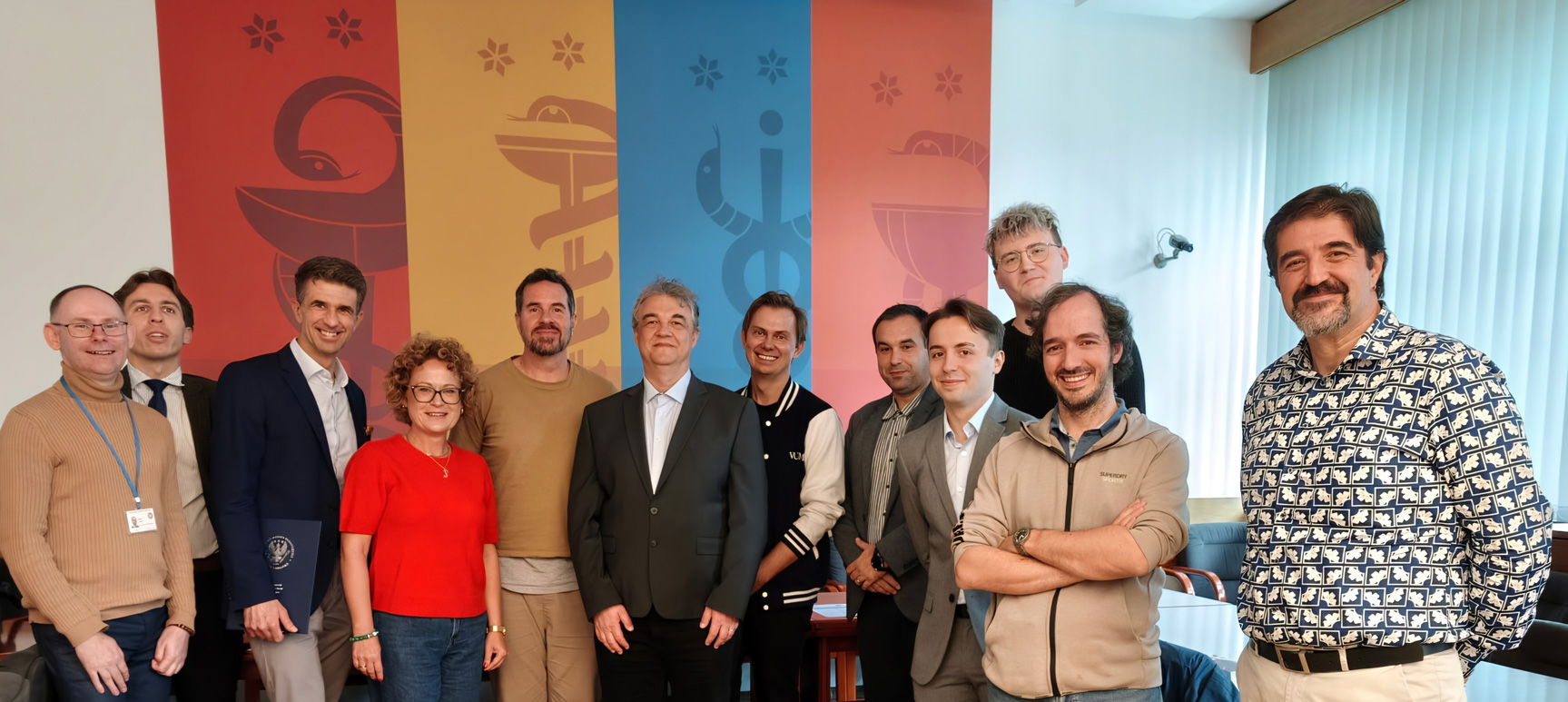
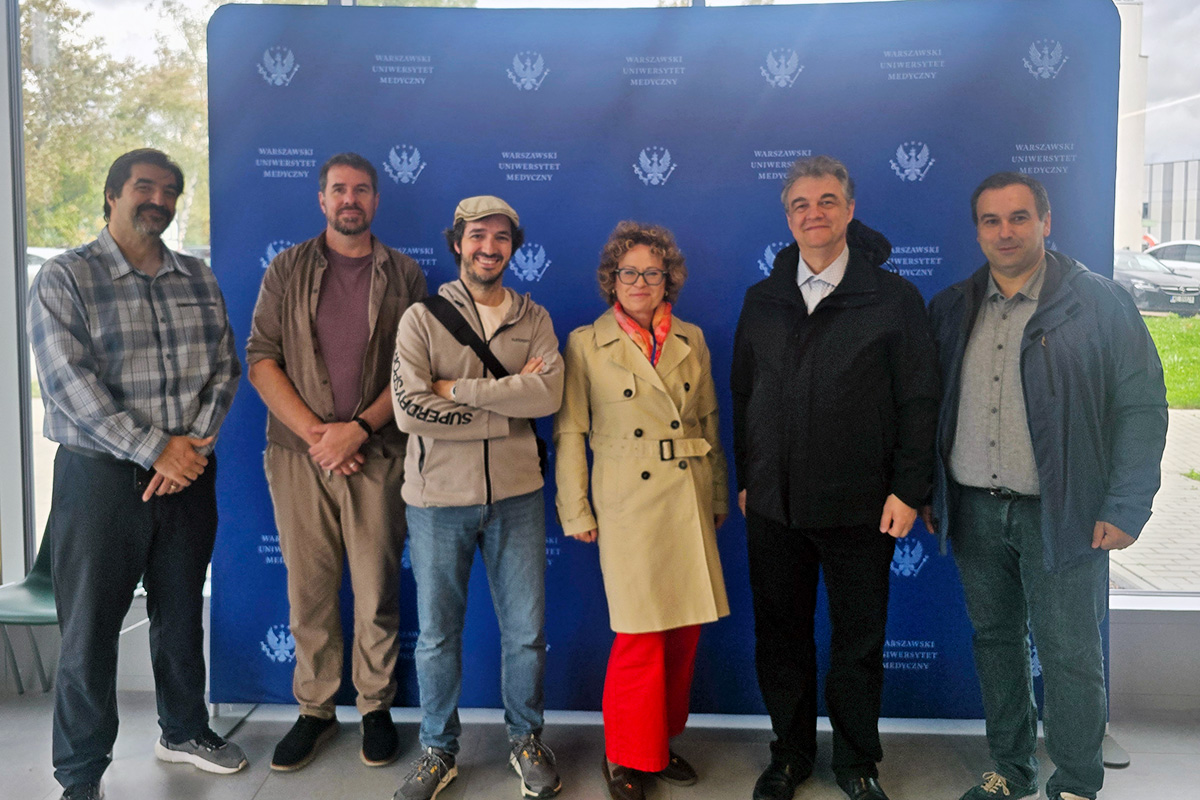
The meeting was attended by representatives of partner institutions from six countries: Marçal Mora Cantallops from the University of Alcalá in Spain (project coordinator), Radu Ciorap and Doru Andriţoi from the “Grigore T. Popa” University of Medicine and Pharmacy in Iași, Romania; Mia Hamill from the European E-Learning Institute in Denmark; Prof. İlkan Tatar from the Faculty of Medicine at Hacettepe University in Turkey; and Leon Quinn from Momentum Marketing Services Ltd (Momentum Consulting) in Ireland.
WUM was represented by Prof. Joanna Gotlib-Małkowska, Dr. hab. Ilona Cieślak, Dr. hab. Mariusz Jaworski, and Prof. Mariusz Panczyk.