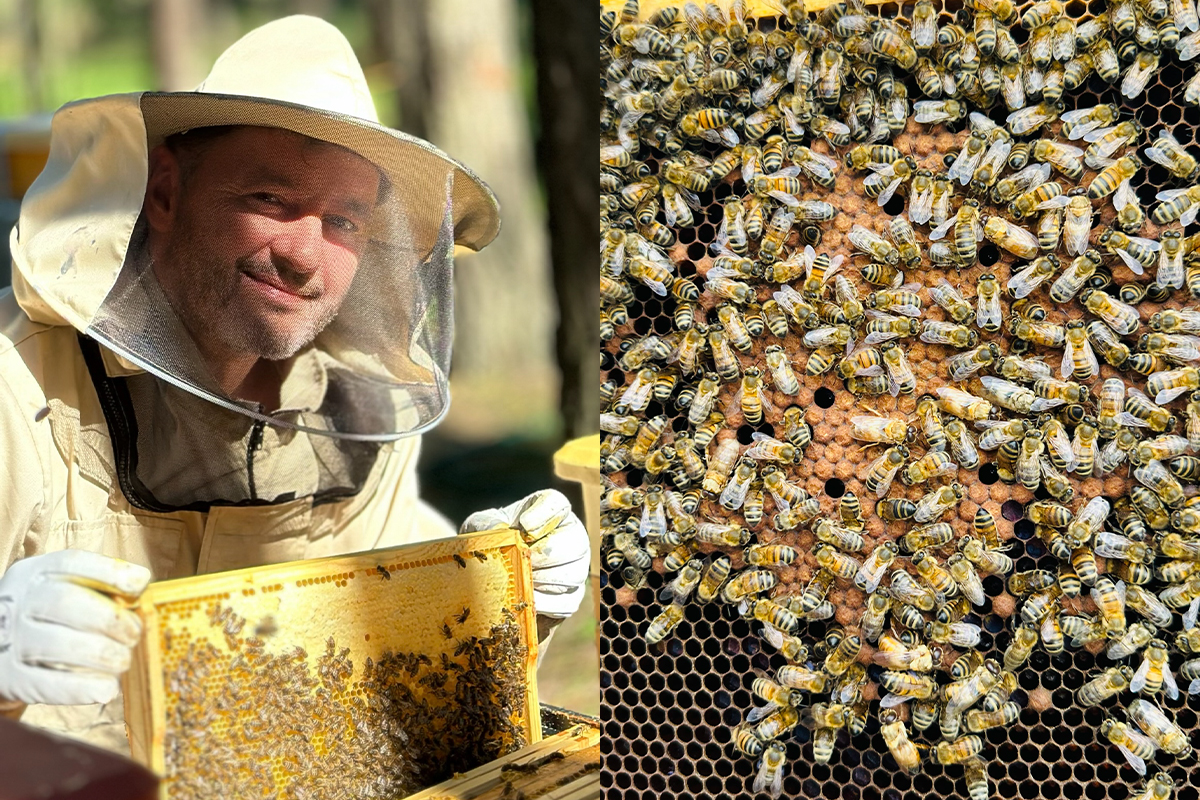
The hives were placed on the roof of the WUM Sports and Rehabilitation Center on World Bee Day 2026. Bee products obtained from them, e.g., propolis or bee venom, will be used for further research carried out in accordance with the principles of evidence-based medicine. The project combines scientific, educational and social activities, while paying attention to the importance of bees for the environment and public health.
Reliable research
The cooperation project between the WUM and the Polish Apitherapy Society (PTApi) was initiated by Dr Mirosław Szczepański, an ENT specialist, a researcher at the Department of Biochemistry of the Faculty of Medicine WUM and the President of the Polish Apitherapy Society, who has also been involved in beekeeping for many years.
"We are starting a unique project. As part of the cooperation between the WUM and the Polish Apitherapy Society, we will carry out a research project on products of bee origin and their potential use in medicine. Hives are placed here to obtain and check the health-promoting potential of bee products in building immunity and in prevention. We have known for centuries that such products have health-promoting properties. At the same time we want to emphasize that we cooperate in this area so that their use is based only on scientific research, and not on folk beliefs or medical myths, of which there are many on the internet," emphasized Dr Mirosław Szczepański.
WUM scientists and members of the Polish Apitherapy Society will work togther to explore the potential use of bee products in modern complementary medicine and preventive healthcare. The goal of this scientific and educational cooperation is to combine the experience of the academic and medical community as well as practical knowledge in the field of bee products. It will involve the implementation of research projects, preparation of scientific publications, educational activities and application for joint research grants. One of the most important objectives of the project is to promote evidence-based medicine and to develop a reliable scientific background for products of bee origin.
Combating misinformation
Combating medical misinformation regarding bee products and promoting knowledge based on reliable scientific data will also constitute an important element of the cooperation. Products of bee origin have aroused great interest for many years, but there are also many oversimplifications and unconfirmed claims concerning their effects. The aim of the project is to separate scientific facts from myths and to conduct research in accordance with the standards of modern science.
The analysis of bee venom and its potential anti-cancer effect is one of the main directions of the research. Research on the effect of bee venom on head and neck cancer cells was and is being conducted at the Medical University of Warsaw by a team led by Dr Mirosław Szczepański and Dr Katarzyna Piszczatowska. The obtained results of laboratory tests in vitro are very promising and indicate the need for further analyses of biological mechanisms related to the activity of selected components of bee venom.
Further research projects on propolis and apiair are also planned, including their antibacterial and anti-inflammatory properties and a potential impact on selected biological processes important for human health.