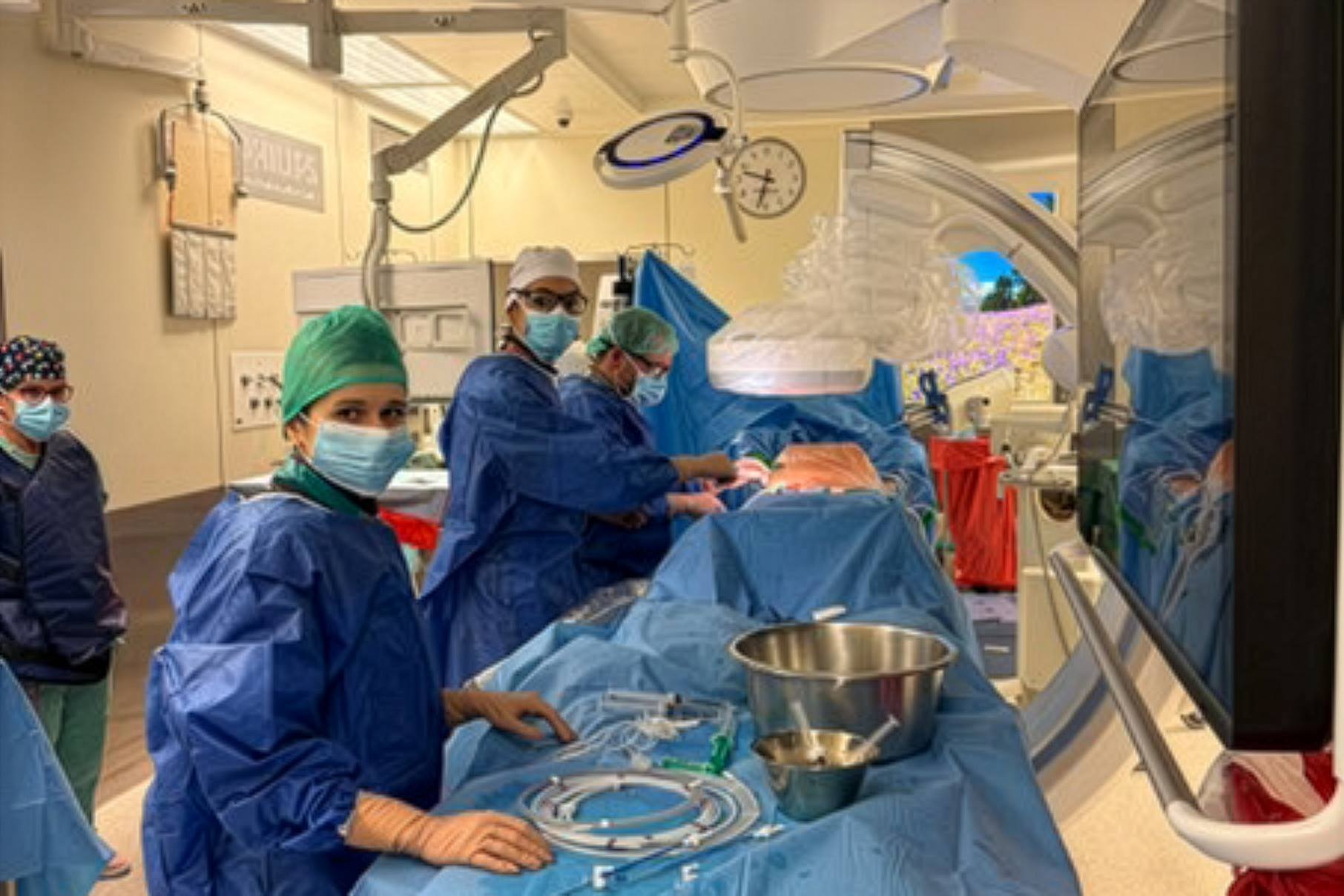
Historically, the first endovascular aortic arch operations using branched stent-grafts were performed with endoprostheses including only two branches: for the brachiocephalic trunk and the left carotid artery. They required additional vascular reconstruction within the neck for normal blood supply to the left subclavian artery. Over time, stent-grafts with three branches began to be used, thanks to which a fully endovascular method may be implemented in the treatment of aortic arch aneurysms and dissections. The stent-grafts with four branches were specially designed for patient anatomy and manufactured by Cook – the world leader in the production of this type of devices.
Benefits for patients
The first patient was 79 years old. The patient had an aortic arch aneurysm, 55 mm in diameter. It was a pseudoaneurysm, which means that there was a very high risk of rupture, which is fatal in 100% of cases. The operation went as planned and the patient was discharged home in a very good general condition after 4 days.
The second one was a 76-year-old man with an aortic aneurysm, 70 mm in diameter, and an aneurysm of the arteria lusoria with a diameter of as much as 51 mm (the normal diameter of this artery is about 10 mm). He was implanted with stent-grafts including branches to four carotid and vertebral arteries, three visceral arteries (the patient had visceral trunk obstruction) and one internal iliac artery, transforming the affected aorta into a so-called "full metal jacket". The operation also went as planned and the patient was discharged home in a very good general condition after 7 days.
Thanks to the use of this type of stent-grafts, the patients avoided a very risky and burdensome open aortic arch surgery necessitating sternotomy, the use of extracorporeal circulation and, most importantly, many months of recovery.
Surgical team
The surgeries were performed in the Department of General, Vascular, Endocrine and Transplant Surgery by the following surgeons: Prof. Tomasz Jakimowicz and Katarzyna Jama, MD PhD, with the participation of anesthesiologists: Bartosz Sadownik, MD, and Paweł Koczara, MD, nurse anesthetists: Marcela Solecki, Msc, and Katarzyna Dołoto, MSc, as well as a team of scrub nurses: Marcin Rosiński, MSc, Edyta Zhulkevych, BSc, and Karolina Grabowska, BSc. The second operation could not have taken place without the support of Vadim Matsibora, MD, from the 2nd Department of Clinical Radiology, who, two months before the implantation of the stent-graft, had embolized the branches of the arteria lusoria, preparing the stent-graft sealing zone. One of the operations was also attended by a student from the Surgery Club, Weronika Niewiarowska.
The team led by Prof. Tomasz Jakimowicz also performed the first in Poland implantation of a stent-graft into the aortic arch (with two branches) on 5 December 2016 and the first in Poland implantation of a stent-graft with three branches on 31 January 2020. The team's experience in endovascular aortic arch surgery, covering almost 150 cases, is the largest in the world and supported by numerous publications in the best journals in the field of vascular surgery.