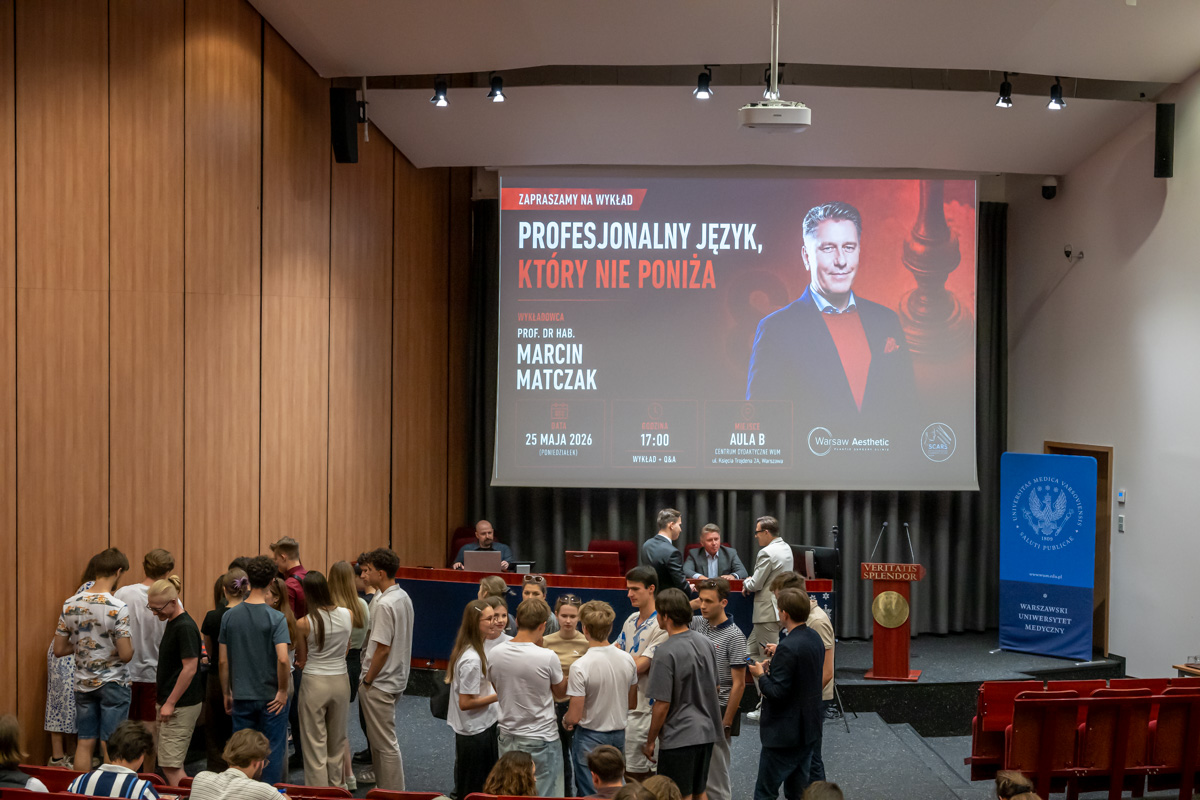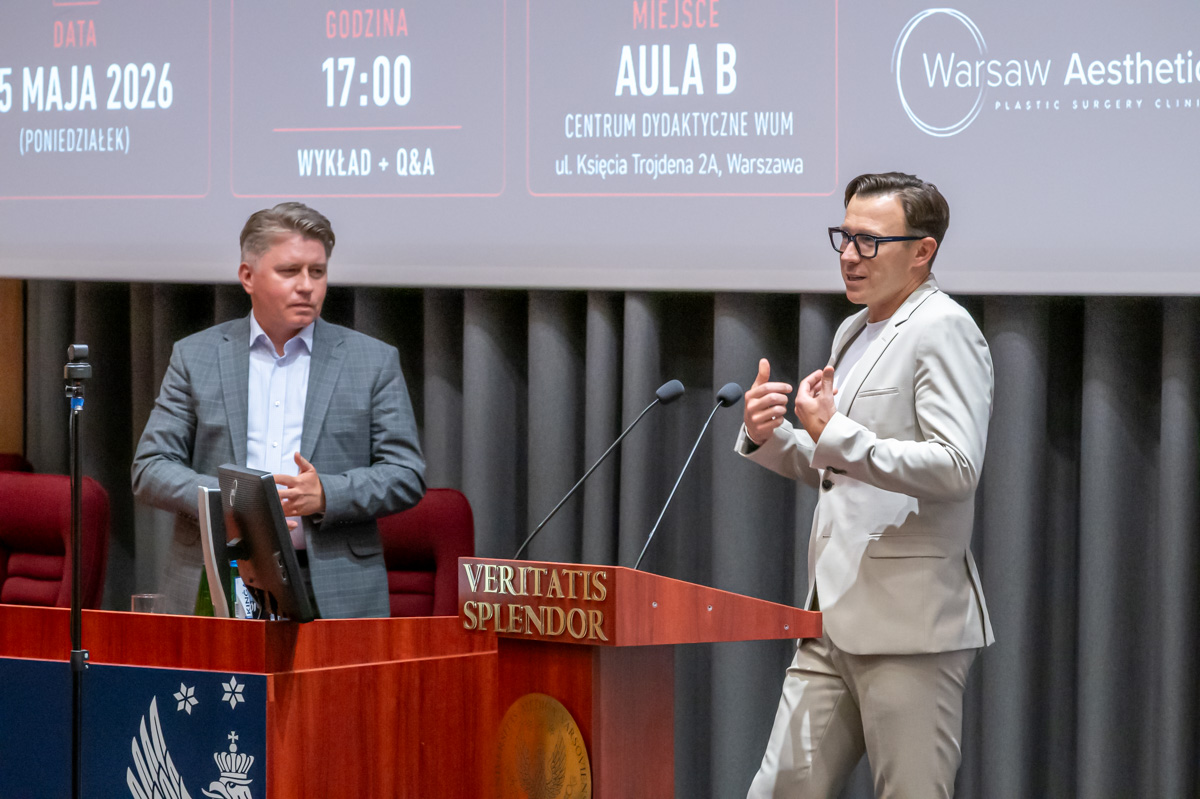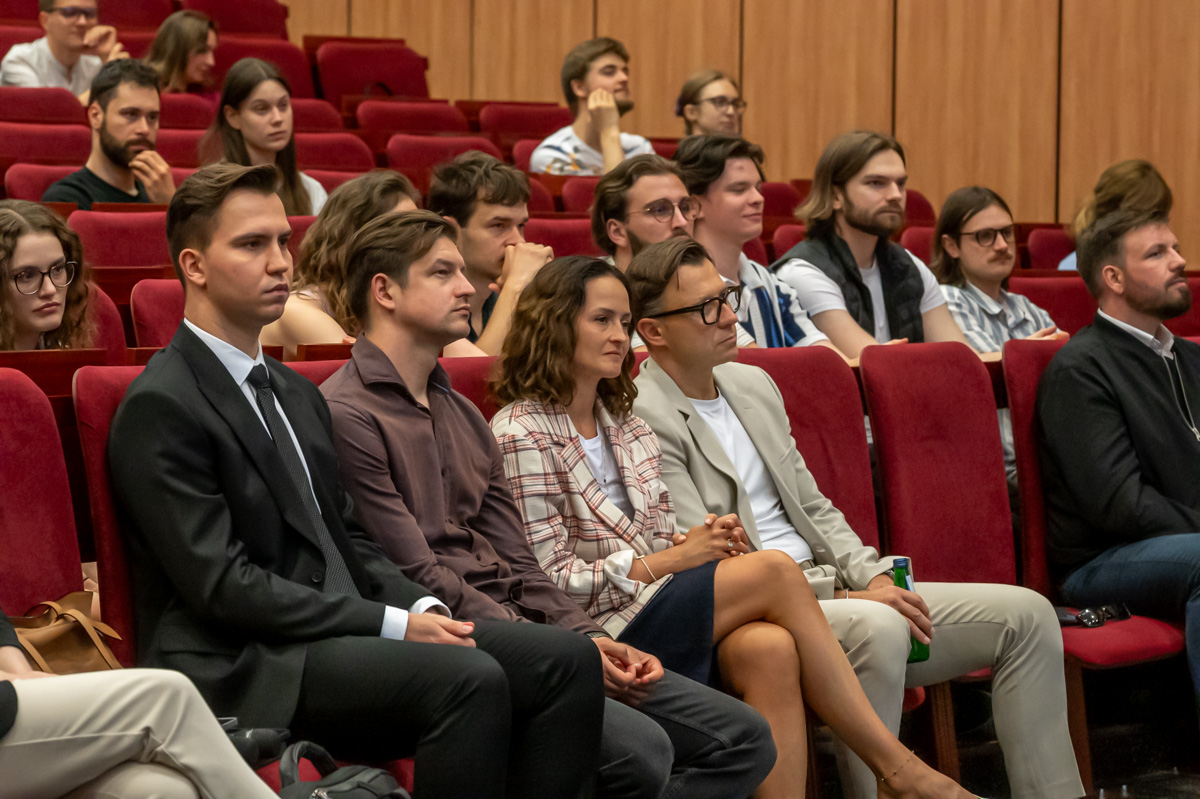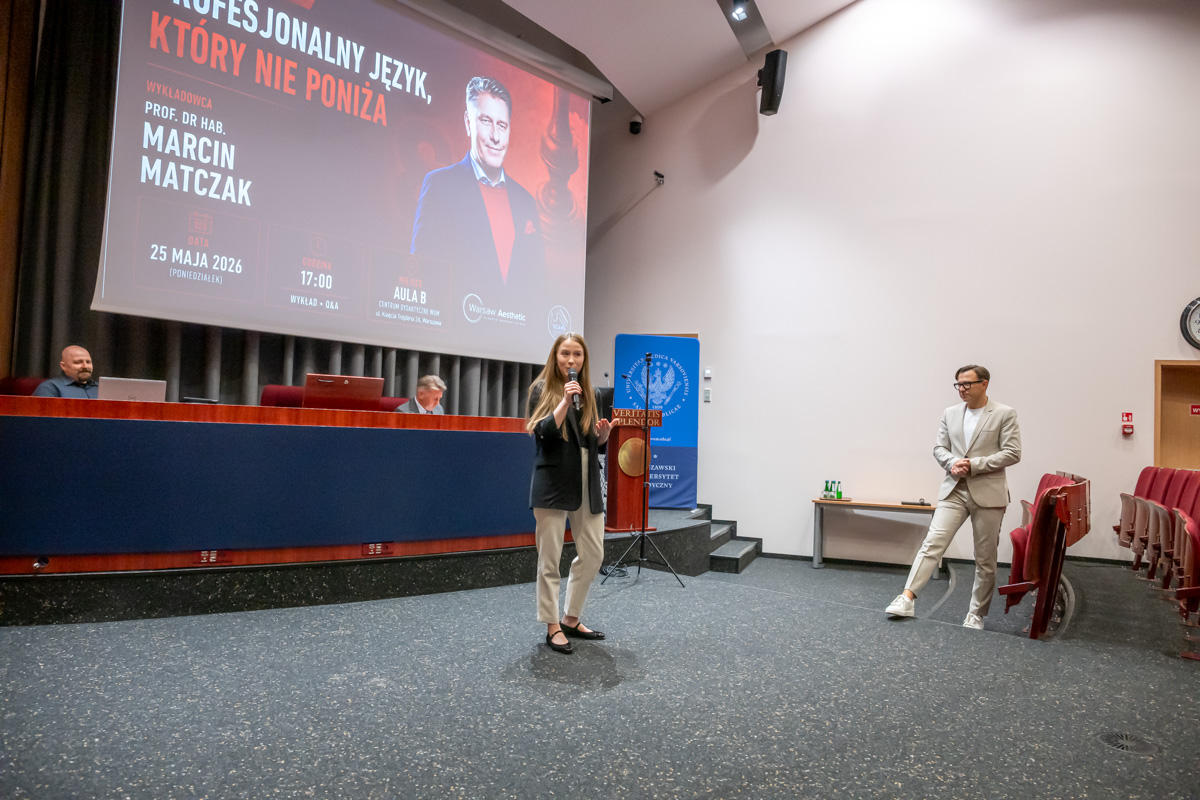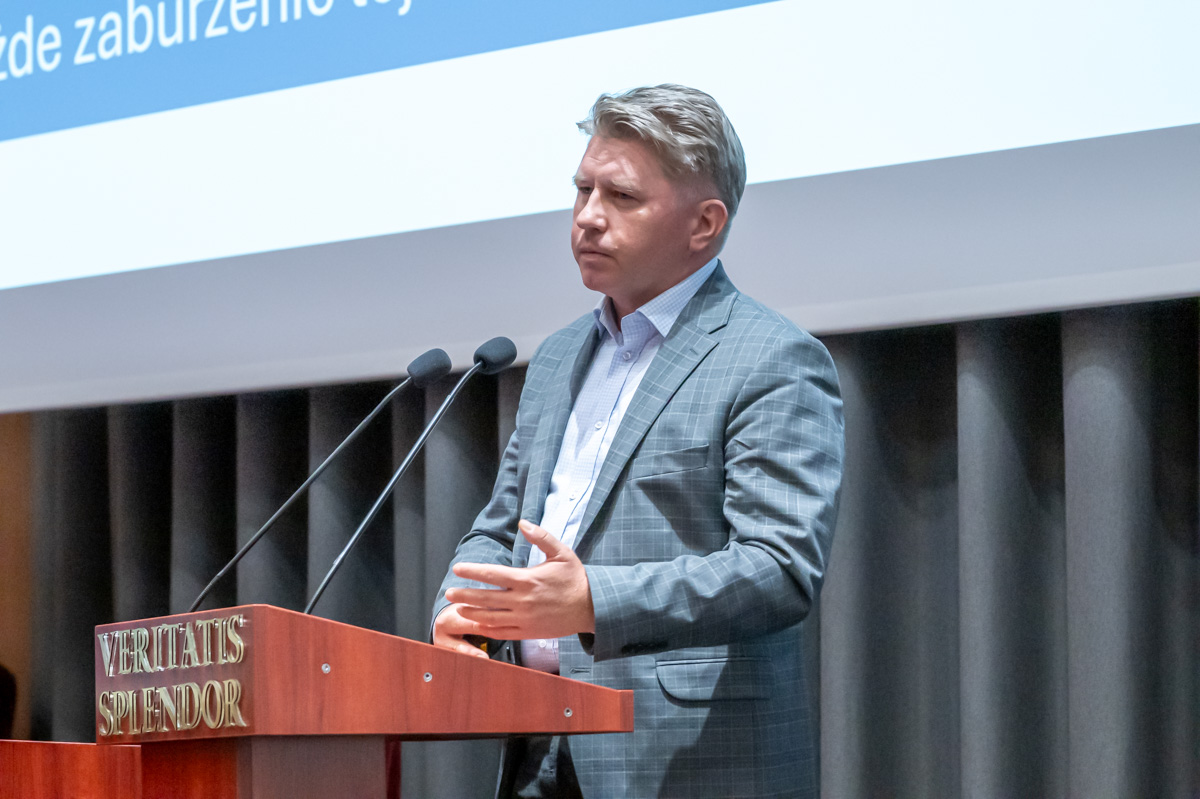
The lecture "Professional language that does not humiliate" was held at the invitation of students from the SCARS Club. Prof. Marcin Matczak, known for his analyses of language and its impact on social attitudes, spoke about the fact that the way specialists communicate – doctors, lawyers or scientists – exerts a direct impact on their relations with listeners and the strength of their social authority.
When a medical professor loses to an influencer
According to Prof. Matczak, complicated, hermetic language – full of jargon, formalism and specialized structures – is sometimes perceived as a way of building advantage and distance instead of strengthening the position of an expert. As a result, the listener not only understands less, but may also feel excluded or even humiliated. The professor referred to three classical means of persuasion described by Aristotle: logos, i.e., the power of a logical argument, pathos, i.e., the impact on emotions, and ethos, i.e., how we are perceived by the listener and how much trust we inspire in them.
"What matters today is our ethos is, that is, how others perceive us, rather than our logos, that is, what we say," argued Prof. Matczak.
He emphasized that a logical argument alone is not always enough. Therefore, a medical professor is less effective at communicating today than an influencer who speaks in simpler terms, draws on experiences closer to the listener’s own and better understands their emotions.
Technological revolutions overturn the status quo
In the speaker's view, communication has become a key tool for doctors, lawyers and other professionals to establish their authority. Knowledge or an academic title alone no longer guarantee automatic social recognition. Listeners expect not only competence, but also understandable language, presence and the ability to build a rapport.
Prof. Matczak pointed out that every technological revolution transforms the way authorities operate. The invention of printing weakened the monopoly of one institution on interpreting the world, radio changed the way politics worked. Nowadays, the internet and AI tools have made access to information universal. In practice, this means that patients come to the office today with a set of reviews they have read, advice they have heard and interpretations they have found online.
How to speak to be heard
The role of the physician as a guide in the world of information overload and disinformation was one of the key themes of the lecture. Prof. Matczak emphasized that it is impossible today to "shut down" the internet or cut people off from AI. This makes professionals who can serve as guides through the chaos of information all the more important.
"A person goes to the doctor with a problem, hoping to find someone there who can help make sense of their world. He is overwhelmed by information, full of anxiety constantly fueled by social media and looking for simple answers. And you often don't have them," said the professor. "To have therapeutic authority, you have to have it in the first place. These days, the authority that comes from holding a title such as "professor" is beginning to fade."
Therefore, according to the speaker, the prerequisite for building authority is to notice the emotional context in which the other person finds themselves. The professional who wants to be listened to must first understand the tension and feeling of confusion the patient is experiencing. Such an approach reduces the susceptibility to disinformation in listeners and strengthens their willingness to cooperate.
How to speak without embarrassing others
One of the key points of the lecture was that overly complex language can be humiliating to the listener, because instead of explaining, it highlights the speaker's superiority. In a professional relationship, especially a medical one, this is of particular importance. Today, listeners want not only to hear an expert, but also understand the person speaking to them.
The professor also included the overuse of foreign languages, Latin and industry jargon among the communication barriers. These are elements that may seem natural in an expert environment, but for a non-expert listener they often become a signal of exclusion.
Communication is also hindered by nominalization, i.e., the conversion of verbs and adjectives into nouns. This is a very common practice in professional language, but it is also one of the things that most distance the message from specifics and action. Expressions such as "take action", "perform a review" or "carry out a procedure" sound official, but unnatural. Simpler equivalents often work better: instead of "conducting an analysis" we can "analyze".
In medical communication, the recommendation "It is important to monitor nocturnal glucose" sounds professional, but it can be much more helpful to tell the patient: "Please, measure your sugar level at 10 p.m."
Competences of the future
The lecturer concluded that "de-formalizing" authority does not translate into abandoning professionalism. On the contrary, it allows the development of a more empathetic relationship, based on trust and understanding. And where empathy exists, there is also a greater willingness to cooperate and follow instructions. Therefore, clear and friendly communication is one of the most important skills today.