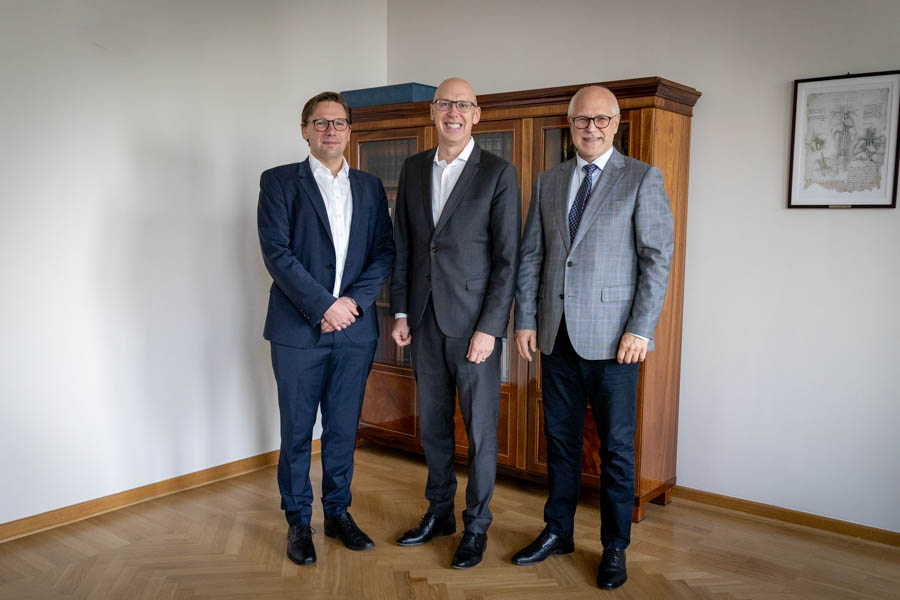
Meeting with the WUM authorities
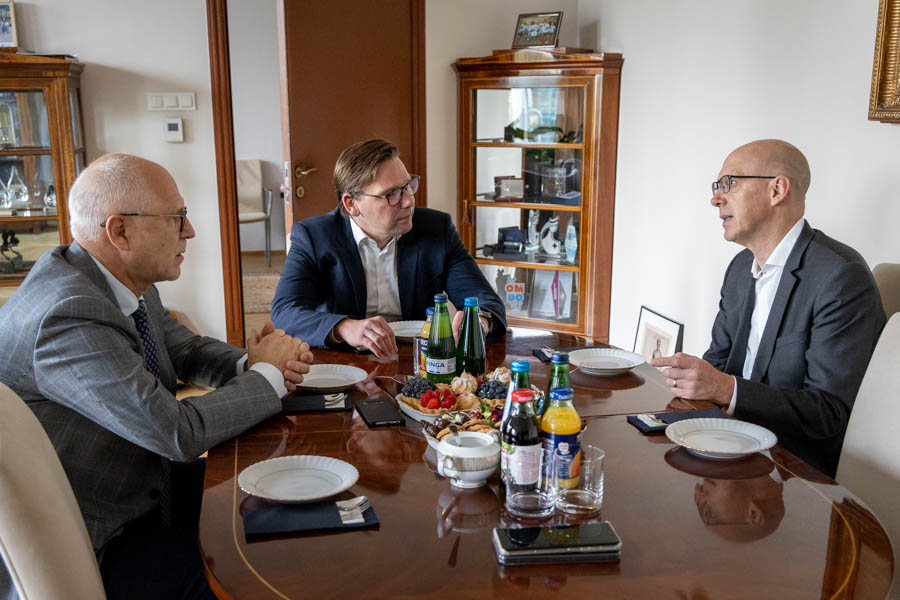
Graham Harrison met with the Rector of our university, Prof. Rafał Krenke, and Prof. Michał Grąt, the Vice Rector for International Relations, Promotion and Development. During the meeting, it was agreed that the review of the research infrastructure of the universities that are members of EUniWell would be the most important element of cooperation by the end of 2026.
“Developing a European map of research resources will increase the possibilities of scientific cooperation within the alliance,” emphasized Prof. Rafał Krenke. “Researchers will gain easier access to the research infrastructure of 12 universities, and young researchers will be able to participate in training sessions organized by the entire partner network.”
Supporting the implementation and development of the micro-credentials system is a crucial element of cooperation within the alliance. A micro-credential is an official proof of learning outcomes achieved through a short course or training program, assessed on the basis of transparent and clearly defined standards. This was also discussed during the meeting.
“Micro-credentials constitute one of the key foundations of modern educational and economic policy of the European Union, aimed at transforming the labor market into the so-called ‘Union of Skills’,” Graham Harrison pointed out.
Micro-credentials are also an important element in the implementation of the idea of lifelong learning and of the creation of the European Education Area and the encouragement of cross-border mobility.
During the meeting, significant attention was also paid to student activities carried out as part of EUniWell. Moreover, the possibilities of academic exchange were discussed. It is a valuable opportunity for students starting a scientific career to develop competences, gain experience and establish international contacts. The possibility of creating joint graduate programmes (second-cycle studies) was another topic of the meeting.
Meeting with scientists and students of WUM
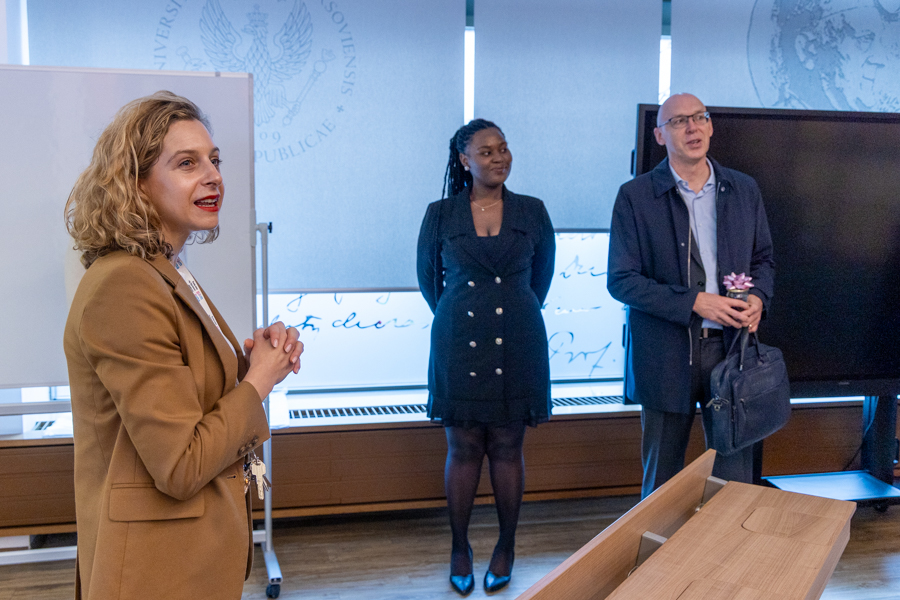
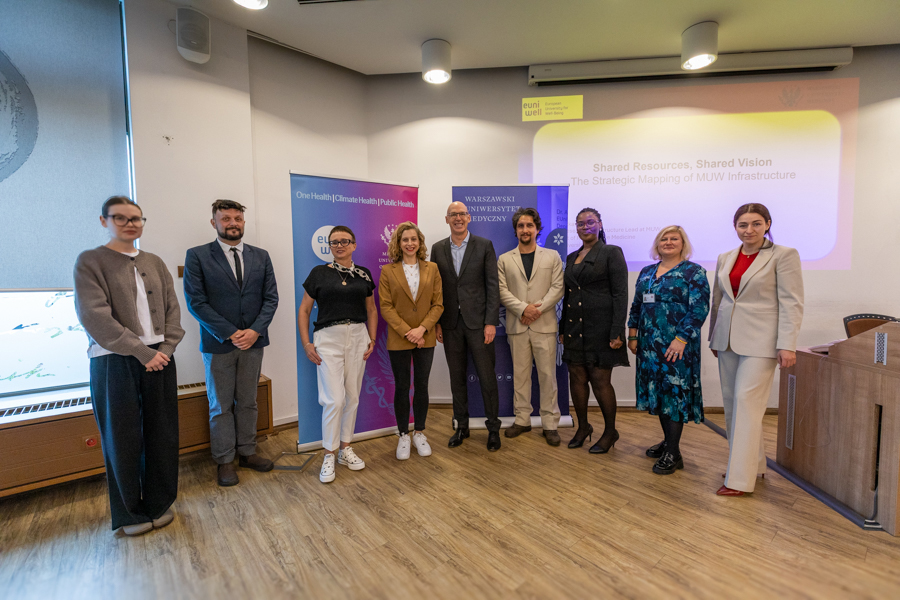
At WUM, activities related to mapping research infrastructure and student initiatives are currently developing very dynamically. In the area of research, there is a growing interest in international cooperation, wider access to the infrastructure of EUniWell partners, as well as increasing mobility and academic exchange. These topics were the focus of Graham Harrison's meeting with scientists and students of our university.
Research cooperation on a European level
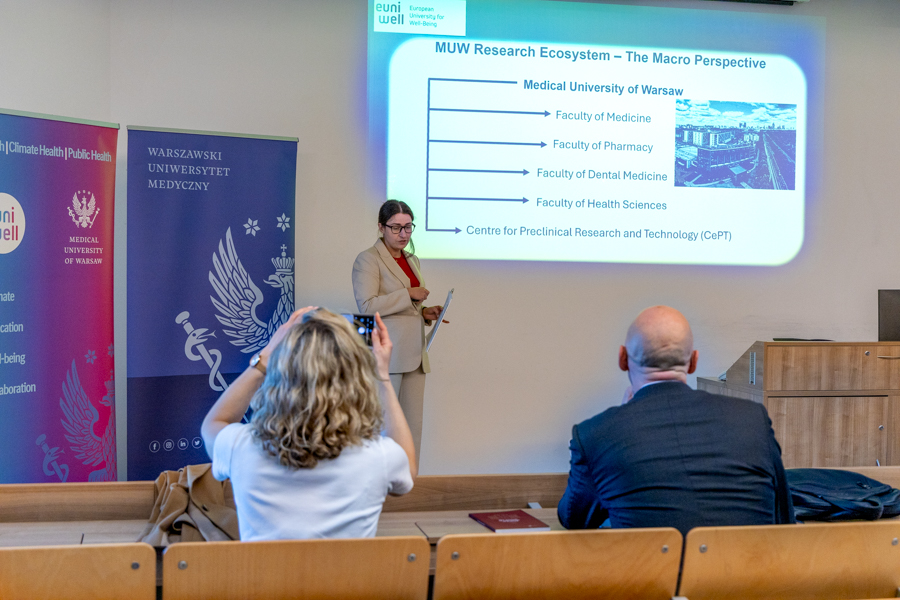
Dr Agnieszka Łukomska from the Laboratory of Regenerative Medicine spoke about the activities carried out at WUM in the area of mapping research infrastructure and the competences of scientific teams. Mapping is a fundamental step in the preparation for the greater involvement of universities in the international exchange of knowledge, experience and research competences within the EUniWell alliance.
Dr Krzysztof Dąbrowski from the Department of Descriptive and Clinical Anatomy presented the assumptions of the GAVTS (Gender Affirmative Vocal Therapy Scale) project, the aim of which is to develop and scientifically validate a tool (questionnaire) used to assess the impact of gender-affirming voice therapy on the well-being of transgender people.
This is the first project of the EUniWell Seed Funding Call competition in which WUM acts as the project leader. The consortium includes: Pomeranian Medical University, Swansea University, University of Murcia, University of Santiago de Compostela, University of Kyiv, the “Nie Widać Po Mnie” (You Can't Tell by Looking at Me) Foundation and the Trans-Fuzja Foundation.
Micro-credentials as part of European cooperation
Arkadiusz Sadura from the Office for the Quality of Education spoke about the participation of WUM in EUniWell working groups devoted to micro-credentials. The university actively follows European solutions in this area and develops its own expertise, at the same time facing challenges resulting from the applicable national regulations, which limit the possibilities of the full implementation of micro-credentials in Poland. Another step will involve the preparation of a joint project with the partners of the EUniWell alliance, implemented internationally.
Student Engagement and Environmental Health
Sylvie Marie Regine Etienne, who represented students, presented the activities of the EUniWell student team at WUM. The implemented initiatives included student integration meetings, an event devoted to mental health, dance workshops, walks with dogs supporting well-being, a meeting with representatives of the Ministry of Climate and Environment.
Finally, Dr Tomasz Warężak from the Department of Environmental Threats, Allergology and Immunology WUM discussed the activities of our university in the area of environmental health, in which students are actively involved. The activities include: collaborating on the development of an action plan for environmental health, projects aimed at the adaptation of Warsaw residents to increasingly frequent heat waves, and cooperation with public administration. Dr Tomasz Warężak also presented student innovations, prototypes and inventions that support health and improve the quality of the life of Warsaw residents.
At the end, he presented the effects of cooperation with universities in Latin America, e.g.,in Colombia, Mexico and Brazil, which has already translated into student academic exchange, One Health, environmental health and technology transfer projects. He also proposed further actions to develop such relations for the benefit of WUM and EUniWell.
What distinguishes cooperation within EUniWell
“What distinguishes EUniWell is, above all, its humanistic perspective on the functioning of the university. Cooperation does not only focus on research, grants or mobility, but on how university influences the well-being of the people who create it,” emphasized Dr Olga Rostkowska, the institutional coordinator of EUniWell at WUM. “The alliance brings together academic staff, administrative staff and students around very universal values. We all want to be healthy, happy, have good relationships and be in good shape. It is difficult to find a more common starting point for international cooperation. Therefore, numerous initiatives are very practical and easily involve people from different backgrounds, disciplines and countries,” concluded Dr Olga Rostkowska.