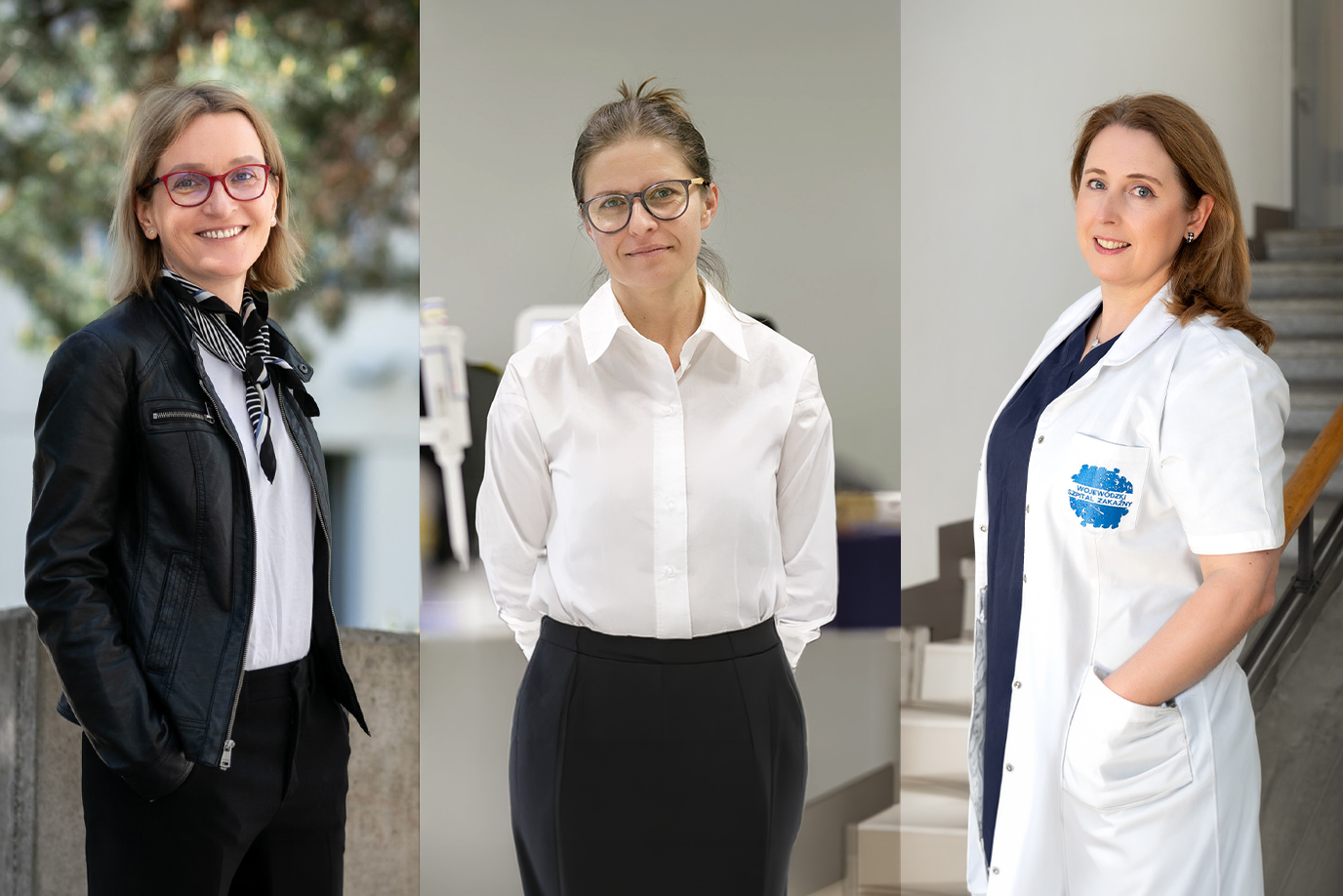
How to combine scientific work with personal life? What is the most difficult aspect?
Prof. Maria Pokorska-Śpiewak from the Department of Childhood Infectious Diseases: Scientific work is not only carried out during working hours, but often requires time at home, in one’s free time or during holidays, especially if you manage large grants. It also involves going to conferences, which are often held at weekends. It is inevitable that involvement in scientific work affects family life. Our loved ones, especially children, do not have to understand and accept this. However, this does not mean that these roles cannot be combined. Despite my intensive scientific, clinical and didactic work, I have three children whose lives I actively participate in. I think there are several keys to success here. First, efficient organization and planning. In order to reconcile multiple life roles at the same time, proper logistics are essential. Mums, especially those with many children, are the best organized people I know. Secondly, it is necessary to share responsibilities and to use the available help and support of the family. We no longer live in multi-generational homes which have always had a grandmother or aunt to help. Today, parents often have to reconcile professional and family duties on their own. However, it is sometimes worth asking for family support. Thirdly, compromises are necessary. You can't do everything at once at a good level. It is necessary to establish the hierarchy of matters and adhere to it. For me, family and children come first, which is why, for example, my husband (also a scientist) and I decided that as long as the children require our presence and supervision, we avoid longer business trips abroad and we are consistent in this. In my opinion, maintaining the distance from everything we do is the most important issue. I often say that I constantly rest – at work from children, with children from work. Therefore, I can look at everything from a broader perspective and not get lost in thinking about problems.
Prof. Dominika Nowis, the Head of the Laboratory of Experimental Medicine: The most difficult thing is the daily need to manage a very limited time so as not to mess anything up. Evening conversation with your daughter or overdue emails? Dinner for tomorrow or an unannounced teleconference? Watching TV series with my husband on the couch or reviewing the latest scientific literature? Hundreds of decisions to make every day... And the brain is constantly at work, without rest, constantly analyzing professional problems in the background... So how to reconcile scientific work with family life? I haven't found such a way although I've searched for it intensively for many years. Today, I rather work from day to day, adapting to current needs. And I see that as our daughter grows up, home and family begin to be more important.
Prof. Magdalena Kucia, the Head of the Laboratory of Regenerative Medicine: For me, combining scientific work with family life has always been a process, not a state of balance achieved once and for all. Reconciling intense research passion with the need to be truly present outside of work was the hardest part. At the same time, it was this passion that brought a lot of joy and meaning to everyday life, which helped to go through more difficult moments. Over time, I have learned to accept that not every stage allows for the same involvement in both spheres and that this is okay. It helped me a lot to understand that I don't have to pursue one "ideal" career model. Curiosity and joy of discovery became a more important compass for me than pace or external expectations. Trusting the team and agreeing that not everything has to be based on my constant presence gave me a sense of greater consistency. It also helped me to understand that the scope of responsibility changes with the development of a scientific career. In addition to research, there is responsibility for the team, younger colleagues and jointly built workspace.
At what stage of your career was the tension between scientific work and family life particularly strong?
Prof. Maria Pokorska-Śpiewak: I think that the most difficult and demanding stage was the time when I was leading a large non-commercial clinical trial with a budget of over PLN 10 million. I had a great sense of responsibility for this project, and as it was the first research of this type in Poland, I had little experience, so problems, especially at the preparatory stage, piled up and required me to be constantly available. I remember my seaside vacation, when my children and husband were spending the day at the beach, I was sitting in a hotel room conducting extremely difficult negotiations to get a drug for the trial. In fact, for several years of this project, I did not have a quiet holiday, despite the fact that I had a great, committed research team and the support of the university. The effort was not in vain – the project was a huge success, both in the scientific and clinical aspect, and today it is indicated as a model of a well-conducted study.
Prof. Dominika Nowis: The first year after the birth of my daughter was the most difficult. I actually "dropped out of the scientific circulation" and a gap appeared in my publication biography. Science hates the vacuum, unfinished projects lose their importance. And the pace of scientific work is getting faster, even inhumane, every year. Today, there are no topics that are not being worked on by several, or more often dozens or hundreds of researchers around the world. It is a very sad moment when we see the publication of another team with the results of "our" project.
Prof. Magdalena Kucia: This tension arises especially in moments of intensive team development and grant responsibility. The pressure of deadlines, assessments and financial decisions on which other people's work depended was clearly noticeable. Looking back, however, I can see that it was those stages that taught me mature energy and responsibility management.
What or who was the greatest support on the scientific path?
Prof. Maria Pokorska-Śpiewak: Throughout my life, I have been lucky to have wise, experienced teachers who were mainly women, which is quite usual in pediatrics. Anyway, I believe that you can and should learn from everyone you meet, also from younger colleagues, who certainly have a different approach, that is more suited to today's reality of work and life. I must admit that I am very lucky that my husband is also a scientist, professor, recognized authority and specialist. Although he deals with a different field of medicine, he has always been a great support for me and taught me a lot, especially at the beginning of my scientific journey. When I doubted my abilities, he assured me that I could do it. Today, we support each other, both at work and – in particular – by sharing parental responsibilities.
Prof. Dominika Nowis: My scientific path was marked out by excellent mentors. They were men, without exception. Very wise people, with great knowledge not only in science but, above all, in life. They were and still are role models for me. I can still talk to them about the avalanche of problems that build up. Today, these are more often problems related to the management of people and their work, because from an active researcher I have become a manager of science, a "facilitator" of the scientific work of younger colleagues.
Prof. Magdalena Kucia: Discussions with experienced people helped me keep my perspective and reminded me that responsibility can and should be shared. My loved ones gave me stability and distance, thanks to which science remained a source of joy, not just a burden. Meetings with women who were passionate and happy about pursuing a career in science, and at the same time remained true to themselves, gave me great motivation.
What can be said to young women who fear that a career in science excludes family life?
Prof. Maria Pokorska-Śpiewak: I believe that where there's a will, there's a way. If someone cares about scientific work, feels it, has such a passion, it will certainly be reconciled with other areas of life. Apart from holding the title of professor, I am also a specialist in two fields of medicine, and at the same time I fulfill myself as a mother of three children. I am strongly involved in their lives, I additionally work for their school community so that they have the best conditions for development. Obviously, some compromise is necessary, making choices, but it is always worth trying, knowing that not everything will always work out and not everything we do has to be perfect.
Prof. Dominika Nowis: The most important thing in life is not to get bored. I know of no work other than research that brings new discoveries every day. The fact that I can learn something new every day makes me see the point of going to work every day. No one knows how to manage time better than us, women. With the support of loved ones, we will always be able to do it. Scientific work means everyday curiosity and development. In my opinion, there is no better recipe for a successful professional life.
Prof. Magdalena Kucia: The curiosity of the world and the joy of searching for answers remain at the core, even when the path to them is long and full of trials. Science teaches patience, resilience to failure and inner honesty. At the same time, it gives great satisfaction and a sense of meaning. A scientific career does not have to, actually it should not exclude other areas of life. However, it requires conscious choices and consistency. In my experience, different areas of life do not have to be mutually exclusive. On the contrary, they often complement each other. Non-professional life gives perspective, distance and energy, which are extremely necessary in scientific work, especially in difficult moments. I have observed many times that people with support outside work are more resilient, consistent and able to develop ambitious projects in the long term. Basing on such a balance, pursuing science becomes not only possible, but also more mature and satisfying.