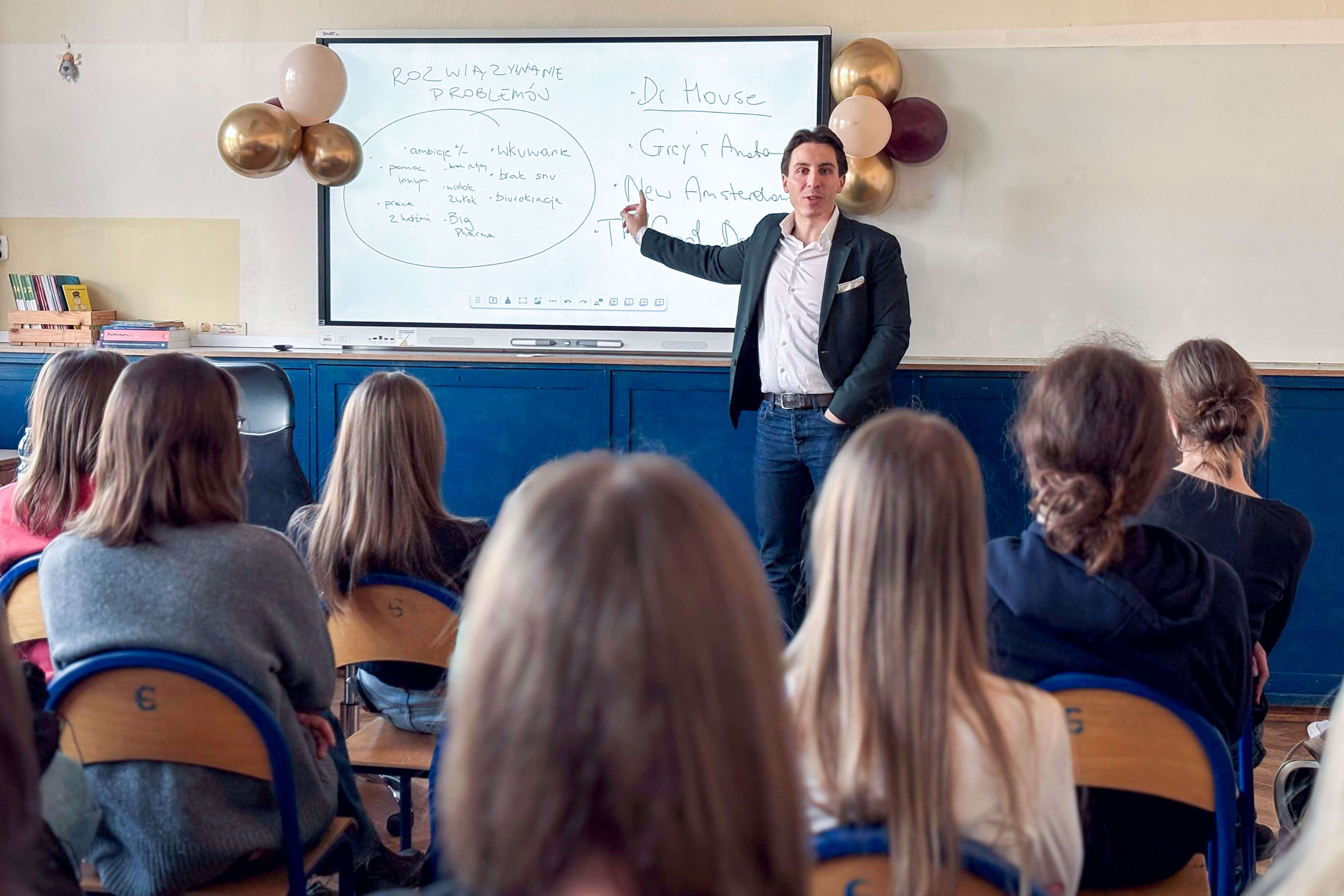
Our university was invited to participate in this year’s Copernicalia, an educational event organized by and for students of 33 High School in Warsaw. The theme of the event was a Renaissance person. Drawing on his own experience, our expert argued that amid orbitals, formulas, and phylogenetic trees, it is always worth seeing the human being.
Who is a Renaissance person?
A Renaissance person is someone versatile, combining knowledge and practice, emotion and science. It is someone who is capable of integrating different fields, associating facts, thinking critically, and maintaining a broader perspective on reality.
“You are becoming educated individuals; this is your peak moment of intellectual development. The fact that you must absorb a vast amount of information does not mean remembering for the rest of your lives, for example, how bryophytes reproduce or what shapes the orbitals of a chlorine atom have,” said Jakub Kosma Rokicki. “The point is to become someone who can connect multiple elements that describe the reality that surrounds us, to understand the processes involved, and to train your brain to think logically.”
A Renaissance person in medicine
Medicine is a creative field, and a medical professional must recognize and solve diverse problems affecting different people. Therefore, they cannot act schematically. Moreover, they should be interdisciplinary and able to connect individual facts into networks of interrelated meanings, just like a Renaissance person.
“The Renaissance was closely linked with humanism, and medicine is the most humanistic of all disciplines because it is oriented toward the human being,” said Jakub Kosma Rokicki.
A Renaissance person in the era of artificial intelligence
As a cardiologist who combines medicine with modern technologies, computer science, and electronics in his professional work, Jakub Kosma Rokicki emphasized that although AI can perform repetitive tasks and can be helpful in medicine, it will not replace humans. Why? Because medical professions require, first and foremost, empathy and an understanding of the human being with their emotions, history, and context. They also require the ability to observe subtle signals, draw conclusions from them, and apply creativity.
“A given symptom complex cannot always be unequivocally linked to a specific disease entity,” the speaker explained. “Artificial intelligence operates through mechanisms that can perfectly reproduce what they already know. However, they are not capable of spontaneously generating a solution that would respond to a new and previously unseen type of data.”
Studies are not an obligation but a choice
At the end, the expert encouraged the high school students to ask themselves why they want to pursue higher education. He suggested that if the goal is career advancement, money, applause, or prestige, it may not be worth it. The best motivation, an internal one, is the opportunity to fulfill dreams and to do something new and exciting.
“If you put yourselves first and determine which motivation guides you, you will be able to protect yourselves from the negative consequences of your decisions. I encourage you always to ask yourselves: Why? For what purpose? Who? Ask these questions regardless of where you are, where you find yourselves, and where you will be,” he said.
The lecture concluded with a discussion with the high school students.