Rare tumor that may cause serious issues
Desmoid tumors, also referred to as fibromatosis, are rare, locally aggressive lesions originating from the connective tissue. They do not form distant metastases, but they can infiltrate adjacent tissues, cause chronic pain, limit function, and disrupt organ function. They also tend to relapse locally.
The course of the disease can be very variable. Some tumors remain stable for a long time, so observation is the initial course of action in some patients. If the tumor enlarges or causes significant symptoms, it may be necessary to use pharmacological, surgical or one of minimally invasive methods.
In the patient who underwent the pioneering procedure, the desmoid tumor was located in the abdominal wall. It was painful and previous pharmacological treatment had not improved the condition. The tumor continued to grow, which is why, after a multidisciplinary evaluation, the patient was qualified for computed tomography-guided percutaneous cryoablation at the University Clinical Center of the Medical University of Warsaw.
Ten needles, carbodissection and precise tomography guidance
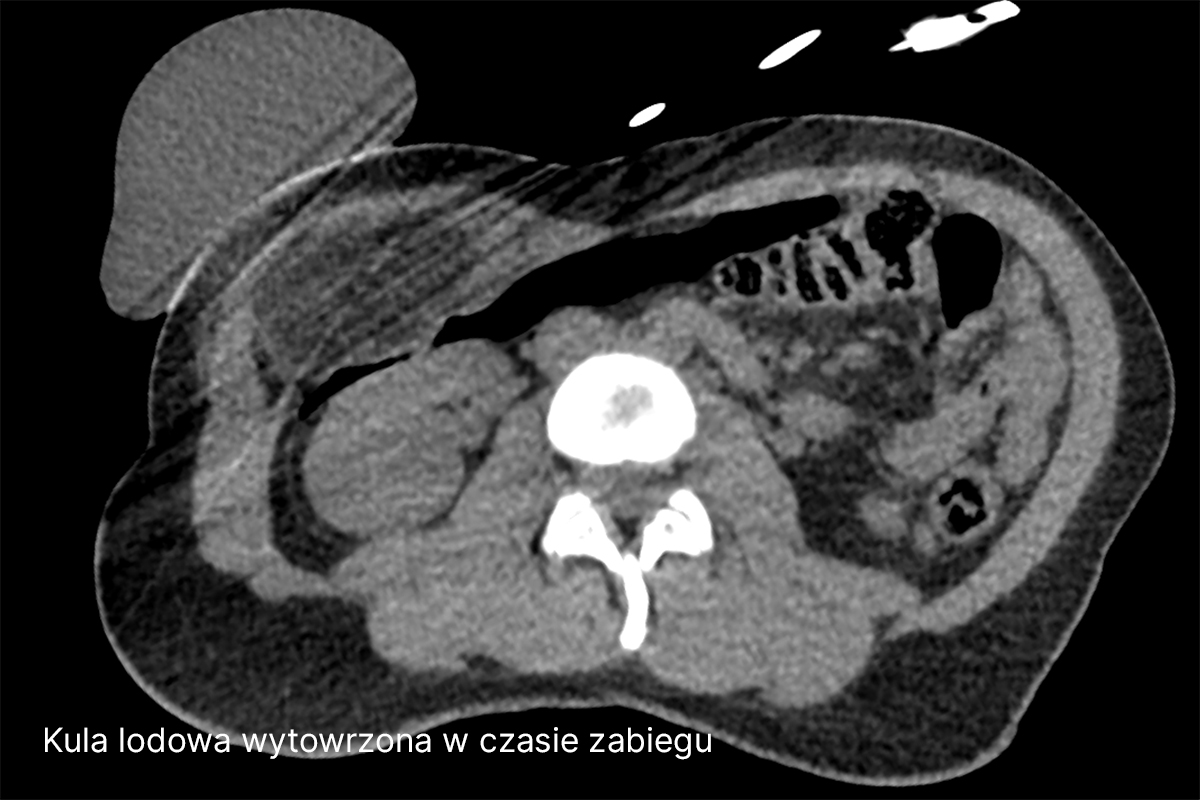
During cryoablation, special needles are inserted into the tumor through the skin. In subsequent freezing and thawing cycles, ice balls are formed around their tips, which leads to the destruction of tumor cells.
The treated lesion was over 8 cm in diameter, which is why the UCC WUM team used as many as 10 cryoablation needles at the same time.
“We had to place all the needles very precisely so that the freezing zones around them would merge and cover the entire tumor, without damaging the adjacent structures,” explained Dr Jakub Franke from the interventional radiology team of the 2nd Department of Radiology of UCC WUM.
Such an extensive and technically demanding procedure required CT guidance, because it accurately showed the entire extent of the forming ice ball and the position of the ball in relation to the surrounding tissues.
The location of the tumor directly next to the intestines constituted an additional challenge for our specialists. To protect them from damage, carbodissection was used, which means that a narrow space was punctured between the tumor and the intestines where carbon dioxide was injected. This created a gas cushion that moved the intestines away from the tumor and protected it from the effects exerted by the ice ball.
The course of the procedure was uncomplicated. The patient remains under further multidisciplinary care, and clinical and imaging control will allow for an assessment of treatment effects. According to the patient, her well-being is improving day by day.
Surgical team
Cryoablation was carried out by a team of interventional radiologists of the 2nd Department of Radiology of UCC WUM including: Dr Jakub Franke, Dr Dariusz Konecki and Dr Krzysztof Milczarek. Justyna Wasilewska-Kukułka, a radiographer, and Aleksandra Pałka, a nurse, also participated in the procedure.
Dr Dorota Giercuszkiewicz and anesthesiological nurse Aleksander Szydłowski were responsible for anesthesiological care.
Pre- and post-operative clinical care of the patient was provided by Dr Tomasz Ostrowski from the Department of General, Vascular, Endocrine and Transplantation Surgery of UCC WUM, headed by Prof. Zbigniew Gałązka.
A less invasive treatment method
Compared to conventional surgery, cryoablation does not require extensive surgical access. The procedure involves performing minor punctures of the skin, which limits the injury associated with the treatment and may allow patients to return to their everyday activities more quickly.
“The choice of this method is always determined by the location and extent of the tumor, the symptoms, the previous course of treatment and the assessment of a multidisciplinary team. Cryoablation is not a substitute for active surveillance, pharmacotherapy, or surgical treatment. However, it expands the range of available possibilities and may be a valuable option for patients whose tumor is growing, causes problems, and previous treatment had not brought the expected results or other methods would be more burdensome,” concluded Dr Jakub Franke.
Cryoablation of desmoid tumors is currently not publicly funded. Both interventional radiologists and oncologists plan to submit a proposal in this matter.