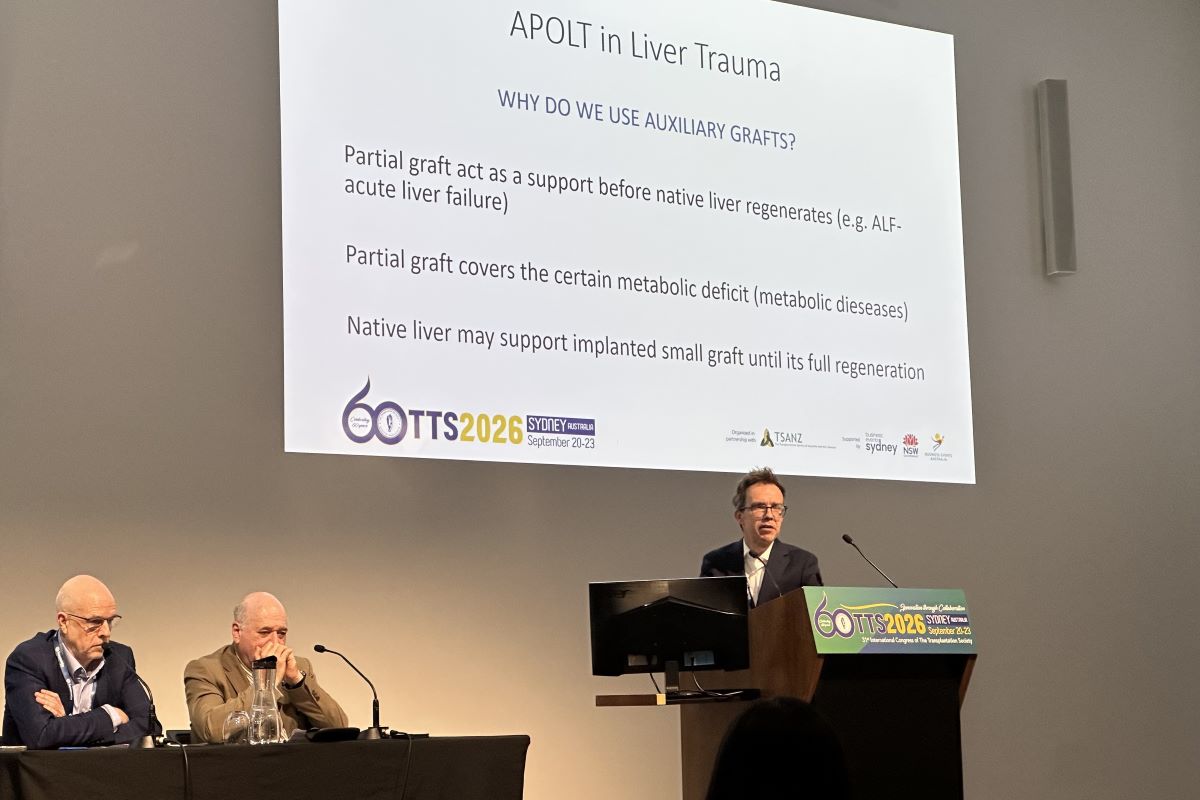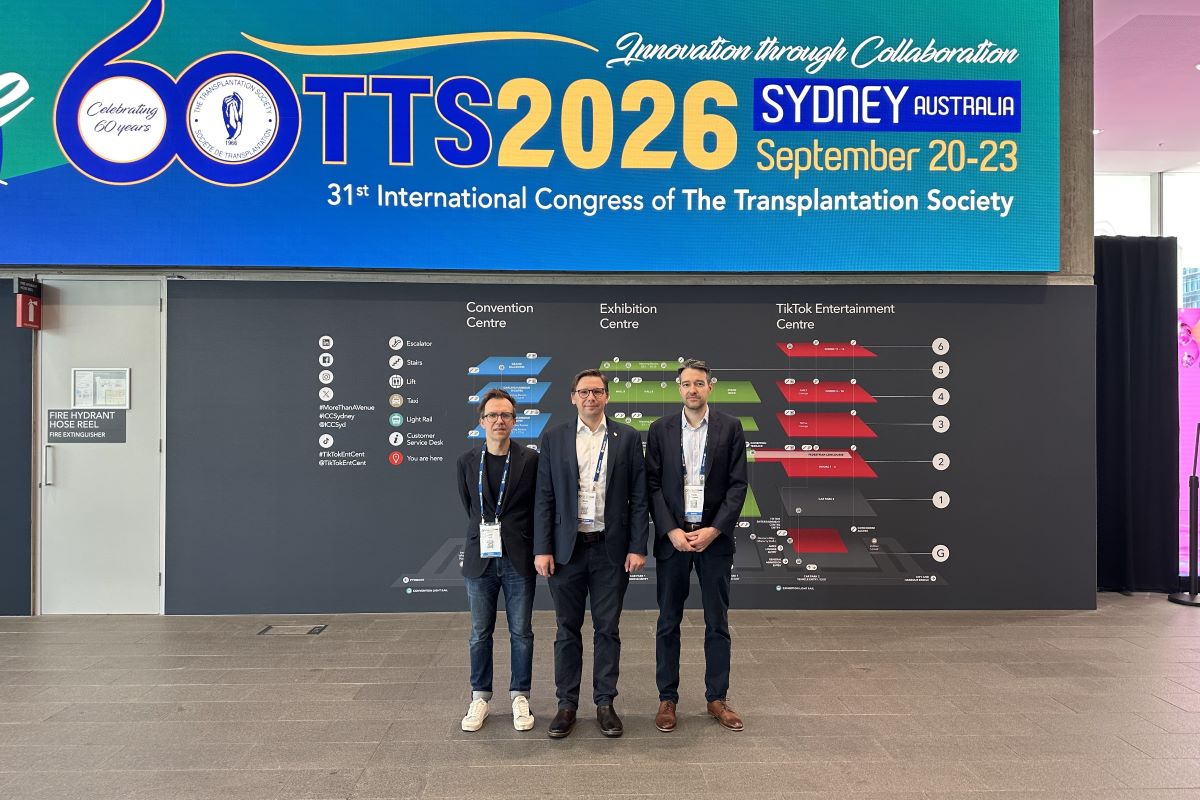
The 31st International Congress of the Transplantation Society (TTS 2026) was held on 20-23 September 2026 in Sydney. The event, entitled “Innovation through Collaboration”, served as a forum for the international transplantation community to exchange clinical and scientific experiences. The Medical University of Warsaw was represented by Prof. Michał Grąt, Dr Maciej Krasnodębski and Dr Łukasz Masior from the Chair and Department of General, Transplant and Liver Surgery.
Two pioneering strategies – new treatment options
One of the main topics presented by our specialists was chimeric liver transplant, which was carried out for the first time in the world at the Medical University of Warsaw on May 11, 2026. This strategy combines oncological surgery, extracorporeal liver resection and transplantation techniques. After removing the organ from the body and excising the part affected by the tumor, the remaining portion of the patient's own liver is connected to a portion harvested from a deceased donor. One functional organ is formed in this way, which is then implanted in the patient. The donor part provides temporary support until proper regeneration and regrowth of the patient's own liver. In the first case, it was possible to remove the donor part after a week and leave the patient only with her own, properly functioning liver.
Auxiliary liver transplantations in patients with extensive liver injuries were the second of the innovations presented by our specialists. The world's first procedure of this kind was performed by the WUM team on May 31, 2024. The strategy aims to preserve the unaffected part of the patient's own liver and temporarily support its function with a transplanted organ fragment from a donor. This enables the regenerative potential of the liver to be exploited instead of replacing the entire organ. After adequate regeneration, it is possible to remove the transplanted fragment and complete the immunosuppressive therapy.
Both strategies share a common goal: saving the patient's life while maintaining the ability to function with their own liver. The transplanted fragment does not have to be used as a permanent replacement for the organ, but it may constitute a temporary support enabling its regeneration. This offers new treatment options for selected patients with advanced tumors or severe liver injury.
Almost 400 transplants per year and broader surgical options
During the congress, the development of the Warsaw center, which currently performs nearly 400 liver transplants per year, was also presented. Such a large scale of activity is a background for gaining experience and developing the most demanding surgical procedures.
The program of the department includes whole liver transplants from deceased donors, split liver transplants for two adult recipients, auxiliary transplantations, and the transplantation of right liver segments from a deceased donor. Extracorporeal liver resections with organ autotransplantation and chimeric transplants are also performed at the center. Therefore, the presented experiences showed not only an increase in the number of procedures, but above all, the expansion of the possibilities of treatment and adapting the surgical strategy to the individual situation of the patient.
The participation of the WUM team in TTS 2026 was an opportunity to present the solutions developed and implemented at our university to the international transplant community. Sharing these experiences supports the internationalization of WUM's scientific and clinical activities and helps build cooperation for the development of new treatment methods.