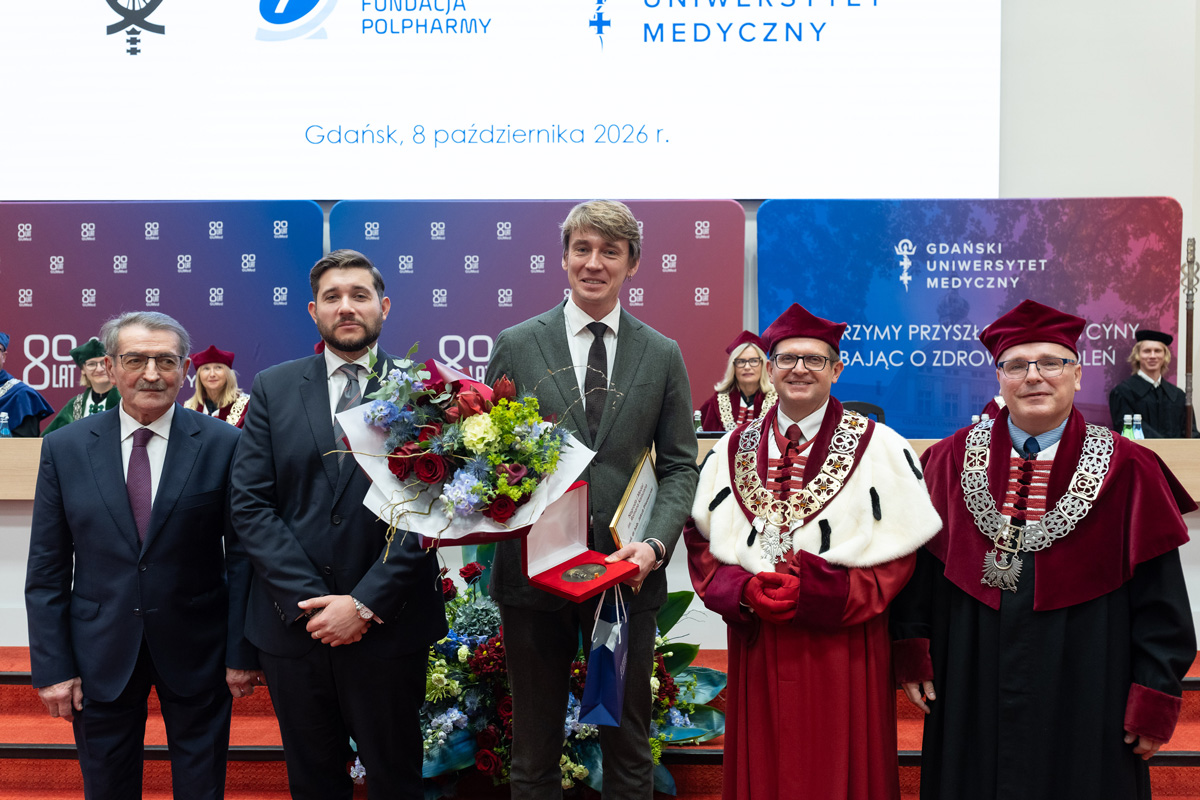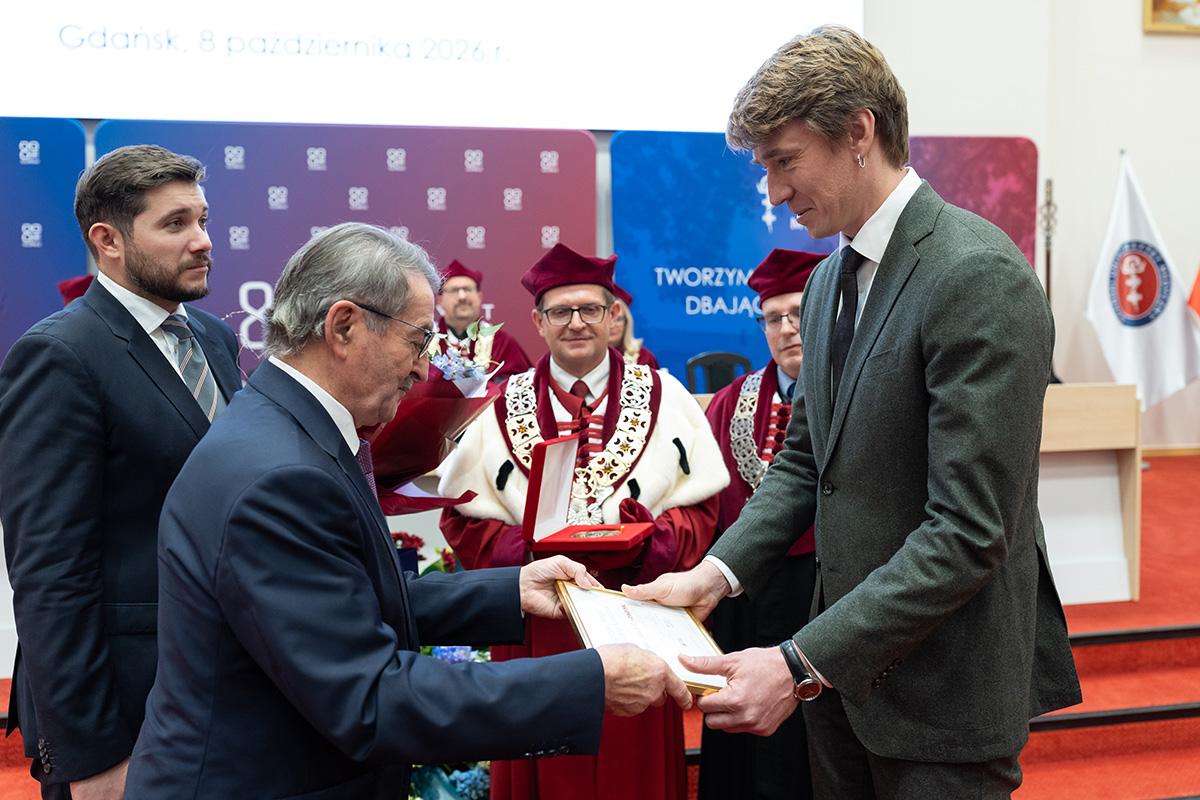
The award is presented by the Medical University of Gdańsk, the Polpharma Scientific Foundation, and the Gdańsk Scientific Society. Prof. Roman Kaliszan, after whom the award is named, was a world-renowned scientist in the fields of pharmaceutical sciences, pharmacology, and analytical chemistry and served as Rector of the Medical University of Gdańsk from 2005 to 2008.
The award was presented during the opening ceremony of the 2026/2027 academic year at the Medical University of Gdańsk.
“Professor Piwowarski combines his passion for research with his scientific work exceptionally well. One of the areas of research he is developing most intensively is the synthesis and use of new postbiotic metabolites as substances with potential applications in the topical treatment of inflammatory skin diseases,” said Prof. Michał Żmijewski, Vice-Rector for Science at the Medical University of Gdańsk, introducing the award recipient during the opening ceremony.
“Thank you for presenting me with this award. I would also like to thank the Medical University of Warsaw for creating opportunities for scientific development and translational research,” said the visibly moved award recipient as he accepted the award. “This medal tells me that the path I chose many years ago is the right one.”
Professor Piwowarski also encouraged students and doctoral candidates to believe in their own ideas, emphasizing that these could eventually lead to practical applications in medicine.
Going against the grain in science
Prof. Jakub Piwowarski’s research focuses on studying interactions between compounds of natural origin and the human gut microbiota. His team is currently searching for new postbiotic metabolites and expanding its research to include the skin and vaginal microbiota, as well as the microbiota of animals.
In 2026, the professor began work on PsiloBiota, the first research project in Poland dedicated to fungi of the genus Psilocybe and funded by the National Science Centre. The project aims to identify new compounds with psychoplastogenic effects and investigate their influence on the microbiota-gut-brain axis.
To mark the occasion, we asked Prof. Piwowarski about his scientific interests, the significance of the award, his advice for young researchers, and his recommendations for those considering studying pharmacy.
What fascinates you most about research on the microbiota?
What fascinates me is that, despite the extensive research already being conducted, there is still an enormous amount to discover, and the findings can be truly surprising. It is also an exceptionally interdisciplinary field that combines microbiology, pharmacology, chemistry, biology, and medicine, making it possible to look at seemingly familiar biological processes from an entirely new perspective.
What does receiving an award named after Prof. Roman Kaliszan mean to you?
When Prof. Roman Kaliszan published a paper in December 1985 on the use of computer algorithms to predict the chromatographic properties of compounds, I was just two months old. At that time, using computer-based computational methods in pharmaceutical sciences was a much less obvious approach than it is today. It must therefore have required overcoming some skepticism toward new techniques and having considerable foresight.
I began researching the human microbiota and its influence on the metabolism of compounds of natural origin in 2011. At that time, relatively few scientists were interested in this subject. It was difficult for me to secure funding for this research and to publish my first papers, which were to form the basis of my doctoral dissertation. To this day, I remember how many doubts and misgivings I had about whether it was worth pursuing. If I could turn back time, I would like to tell my younger self: “These ‘strange’ things you are doing in the lab will one day be recognized.”
What advice would you give young scientists who dream of making discoveries and having a real impact on the development of science?
They should go against the grain, but never take shortcuts. Although many attempts may fail (my drawer is full of ideas that did not work out), this is the only way to learn something new about the world, which is increasingly being viewed through the lens of probabilistic algorithms.
What would you tell high school graduates about the opportunities this field opens up in modern science and why it is worth studying?
A career in pharmacy offers considerable professional stability, and job security is a particularly valuable asset today. Of course, the pharmacy profession, like many others, will change under the influence of the digital revolution. The key will be to modernize the educational process appropriately and develop legislative solutions that allow graduates to make full use of the skills they acquire during their studies. I am already encouraged to see pharmaceutical care developing, efforts being made to enable pharmacists to establish independent practices, and clinical pharmacists gradually becoming part of the therapeutic process.
I therefore believe that studying pharmacy offers, on the one hand, the opportunity to pursue a socially valuable and stable profession and, on the other, a wide range of opportunities for professional and scientific development.
At the same time, it is difficult to imagine a time when society’s access to professional, evidence-based care in pharmacotherapy would be more necessary than it is today. No one is better qualified in this respect than graduates of pharmacy programs.
About the award recipient, Professor Jakub Piwowarski
Professor Piwowarski is a co-inventor of European and U.S. patents and patent applications protecting methods for producing and using urolithins and other metabolites generated by the gut microbiota. He has led research and implementation projects funded by the Medical Research Agency, the National Science Centre, the National Centre for Research and Development, Deutsche Forschungsgemeinschaft, and the Ministry of Science and Higher Education. He is a fellow of the Alexander von Humboldt Foundation and a recipient of a START scholarship from the Foundation for Polish Science. In 2017, he received the Bionorica Phytoneering Award for his scientific and translational work, presented by the Society for Medicinal Plant and Natural Product Research and Bionorica. In 2019, he received the Minister of Science and Higher Education’s scholarship for outstanding young scientists.
Photo: Dawid Linkowski, Medical University of Gdańsk