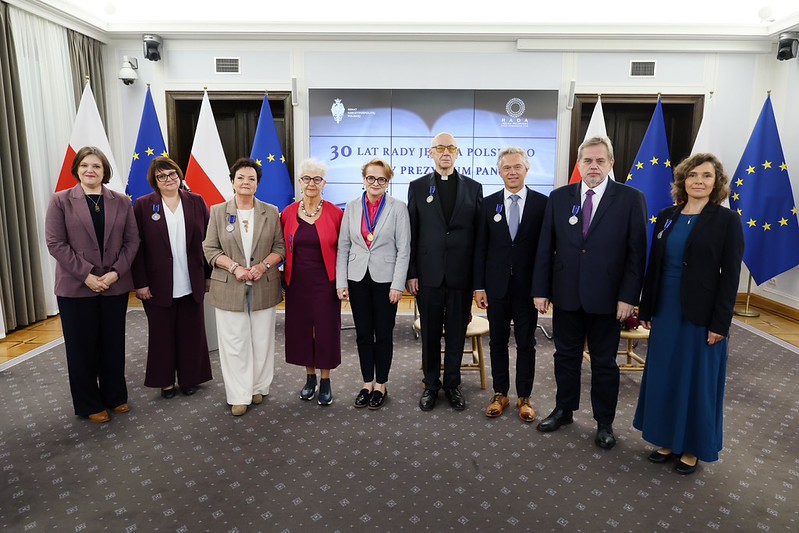
The medal is awarded by the Minister of Science and Higher Education for contributions to higher education and science, including outstanding achievements in scientific, teaching, or organizational activities. In addition to Dr. hab. Antonina Doroszewska, seven other members of the council also received medals.
The medals were presented by Karolina Zioło-Pużuk, Secretary of State at the Ministry of Science and Higher Education.
“Thank you for your work in promoting knowledge, for showing us that language is alive and evokes emotions. I envy you the ability to set standards for what is first and most important to us, namely our native language,” said Deputy Minister Karolina Zioło-Pużuk. (Source: Polish Academy of Sciences)
Language in medical communication: why does it matter?
Dr hab. Antonina Doroszewska emphasizes that modern medicine is not only about knowledge and advanced technologies, but also about the ability to communicate clearly and precisely.
“Doctors use words to take a medical history, explain a diagnosis, discuss risks, obtain informed consent, make decisions together with patients, and formulate a treatment plan. Imprecise or unclear messages can therefore lead not only to misunderstandings but also to incorrect decisions,” explains Antonina Doroszewska.
The Head of WUM’s Department of Medical Communication adds that the language used by health care professionals reflects their attitude toward the patient and their professionalism. Choosing words appropriate to the patient’s language skills also helps the patient feel safe and cared for.
How we talk about health and medicine is also extremely important in an age of widespread access to information, as well as growing misinformation.
“Medical communication should not only be understandable to its audiences, but also engaging and conducive to building trust. This applies both to direct conversations between doctors, nurses, dietitians and other specialists and their patients and to communication between medical institutions and the public. These are the issues we address at WUM’s Department of Medical Communication and within the Language in Medicine Team of the Council for the Polish Language at the Presidium of the Polish Academy of Sciences,” says the head of the program.
Photo: Tomasz Paczos / Chancellery of the Senate