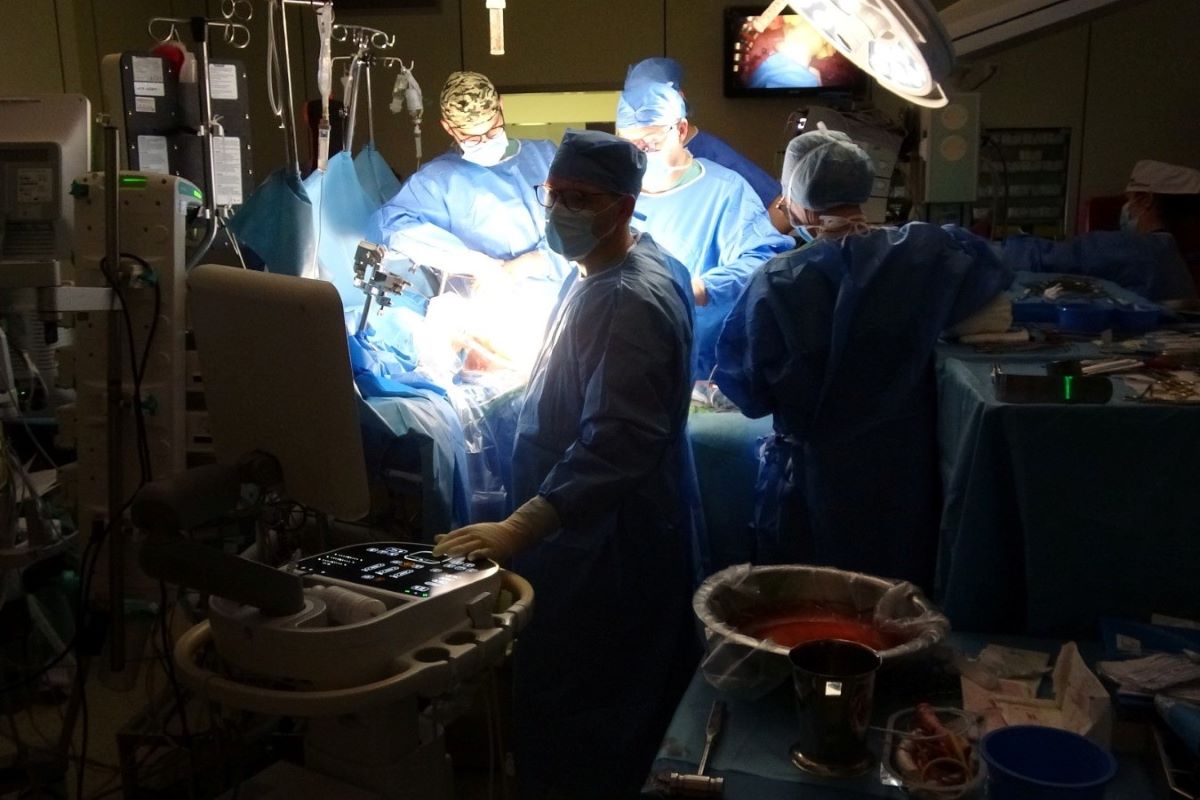
Prof. Michał Grąt, together with a team of surgeons from the Department of General, Transplant and Liver Surgery at the Medical University of Warsaw, performed the second successful liver autotransplantation in Poland on March 30, 2026. Transplant techniques and ex vivo hypothermic oxygenated machine perfusion (HOPE, 9°C) were used to support and regenerate the remaining portion of the patient’s own liver. The procedure was performed in a patient with a giant hepatic hemangioma, a benign tumor that was life-threatening in this case. The lesion, weighing approximately 8 kg, filled most of the abdominal cavity and, by compressing the remaining liver parenchyma, led to liver failure due to impaired venous outflow. The operation was successful. The patient was discharged home in good condition on postoperative day 10.
Why autotransplantation instead of standard liver transplantation?
In this case, standard liver transplantation was a potential therapeutic alternative. However, the team chose autotransplantation, as it was considered more beneficial for the patient. The main rationale was the potential to achieve radical treatment without the need for long-term immunosuppression and to avoid some complications typical of allotransplantation (transplantation from another individual), including the risk of graft rejection and complications related to chronic immunosuppressive therapy. As a result, the patient retained her organ after tumor resection and reimplantation.
Treatment course: autotransplantation + ex situ resection + HOPE
During the combined procedure, the surgical team temporarily removed the liver and performed ex situ tumor resection, which was followed by reimplantation of the remaining portion of the patient’s own organ (autotransplantation). After tumor removal, a liver remnant weighing approximately 1100 g regained sufficient function after HOPE machine perfusion, allowing the safe completion of the procedure and postoperative recovery. The liver remained outside the patient’s body for seven hours, and the total duration of the surgery was 13 hours.
“In this surgery, the key objective was to combine transplant techniques with the possibility of ex vivo functional support of the patient’s own liver fragment. Autotransplantation allows us to avoid immunosuppression and its long-term consequences, while offering a chance for radical treatment in a life-threatening situation,” emphasized Prof. Michał Grąt.
First use in Poland of ex vivo regeneration of the patient’s own liver with HOPE
The most innovative aspect of the procedure was the first use in Poland of HOPE (hypothermic oxygenated machine perfusion) for ex vivo regeneration and functional support of a fragment of the patient’s own liver. The perfusion lasted 2 hours at 9°C.
Team composition
Abdominal stage (patient procedure): operator: Prof. Michał Grąt, assistants: Dr. Piotr Remiszewski, Dr. Paweł Topolewski
Ex vivo liver surgery (ex situ stage): operator: Prof. Michał Grąt, assistants: Dr. Konrad Kobryń, Dr. Piotr Smoter
Ex vivo perfusion (HOPE): Dr. Mateusz Bartkowiak, Dr. Konrad Kobryń
Anesthesia: Dr. Marta Dec
Anesthesiology and nursing team: scrub nurses: Anna Wasik, Beata Zadowska, Karolina Kulesza, Julia Górska; anesthesia nurses: Aleksandra Woźniak, Weronika Śmigielska
Coordinator: Krzysztof Zając
Key facts at a glance
Procedure date: March 30, 2026
Diagnosis: giant hepatic hemangioma; tumor mass: approx. 8 kg
Liver remnant mass: approx. 1100 g
Clinical condition: liver failure due to impaired venous outflow
Alternative: standard transplantation possible; autotransplantation chosen, primarily to avoid immunosuppression
HOPE: 2 hours, 9°C
Ex vivo liver time: 7 hours
Total operation time: 13 hours
Outcome: discharged home in good condition on postoperative day 10