The heritage of the school of Professor Adama Gruca, from which our department originates, creates an obligation to be courageous and innovative, and to strive for perfection. Both procedures prove that we are capable of both effectively carrying out large-scale microsurgical reconstructions, and using state-of-the-art personalized implants. Yet the most important thing is that this allows us to offer patients world-class treatment,” explains Professor Paweł Łęgosz, Head of the Chair and Department of Orthopedics and Locomotor Traumatology, WUM UCC.
Reconstructing the Tibia with a Vascularized Graft and Microsurgery
The procedure was performed on a patient with a severe infection following tibia fracture, which had resulted in extensive bone loss that made standard treatment impossible.
The team from the Chair and Department chose a procedure reserved for the most difficult cases, which involved several stages:
- sampling a vascularized bone graft from the pelvis,
- transferring it to the site of bone loss,
- connecting the vessels using microsurgery, under a microscope,
- stabilizing the site using Ilizarov apparatus.
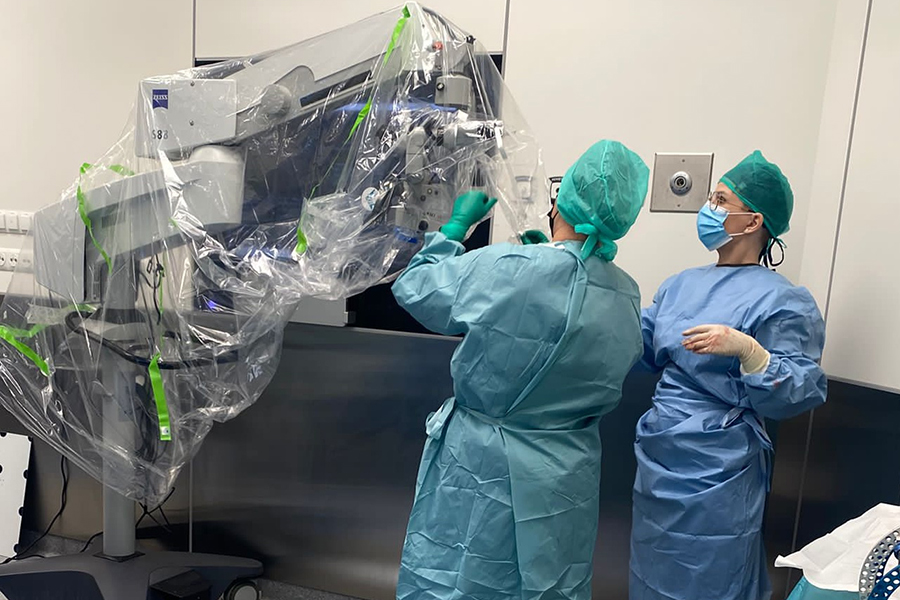
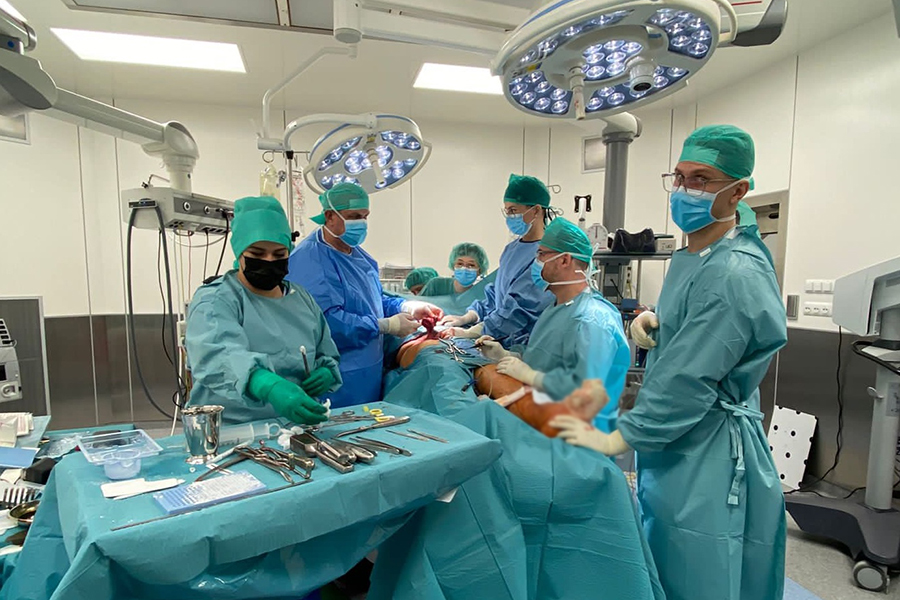
The procedure was conducted by Professor Łukasz Krakowczyk, Radosław Górski, PhD, Bartosz Pachuta, PhD, Dr. Aleksandra Sibilska, and Dr. Marcin Wyglądała. Additionally, Professor Łukasz Krakowczyk was invited to join the operating team, being one of the most excellent microsurgeons in Europe and co-author of pioneering facial grafts and reconstructions of complex tissues in the neck. His experience was crucial for restoring the vascularization of the graft and reconstructing bone structure (Photos 1 and 2).
The procedure gives the patient a real chance of regaining function in that extremity, and may be considered as one of the most advanced modern reconstructive solutions.
Precise Reconstruction of Knee Cartilage Using 3D Technology and Episurf implant
The procedure was conducted in a female patient with pain in the medial section of the knee, caused by focal cartilage loss in the medial femoral condyle.
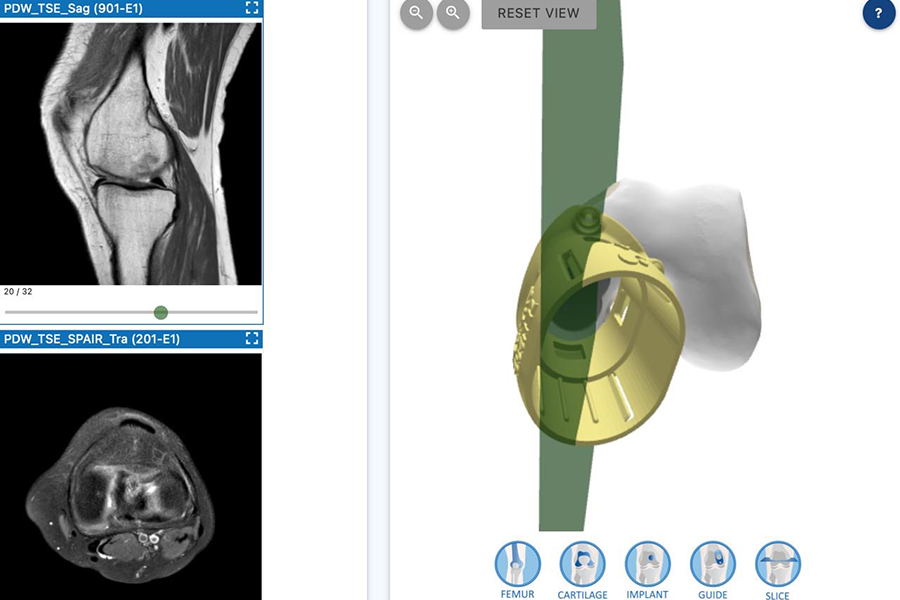
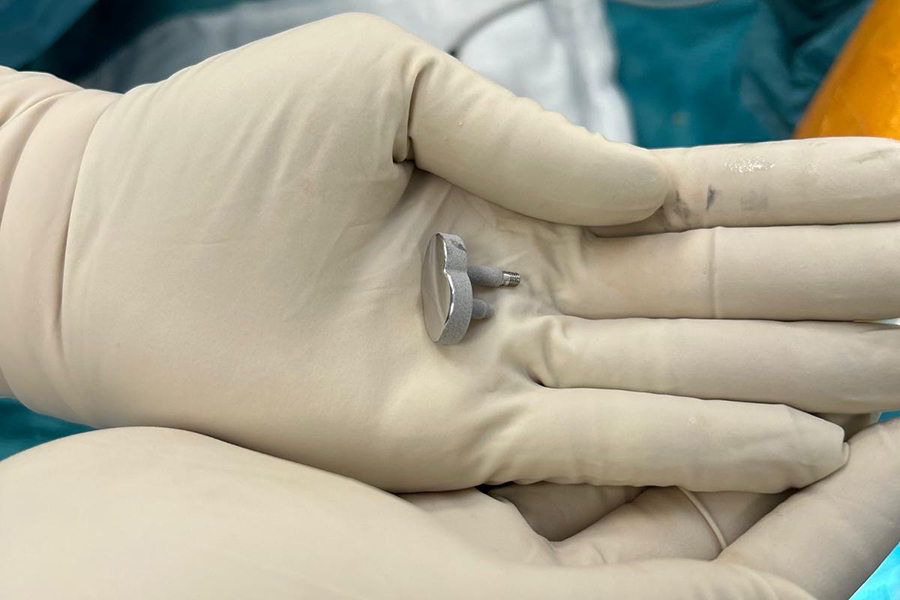
The department’s team inserted a custom-made implant, prepared individually based on magnetic resonance. The implant had been covered with a layer that facilitates the implant merging with the bone, which enhances the durability of reconstruction (photos 3 and 4). In the procedure, 3D-printed tools were used, which allowed for the precise bed preparation for the implant.
The operating team included Łukasz Pulik, PhD, Marcin Kowalski, PhD, and Dr. Maciej Janowski.
The Chair and Department of Orthopedics and Locomotor Traumatology, WUM UCC, is famous for its solutions involving 3D-printed implants, starting with mega implants of the pelvis, through tailor-made shafts for the hip joint endoprosthesis, to mini-implants of the joint surface.
Applying personalized implant surgery significantly broadens the opportunities for treating focal cartilage damage in patients who so far had very limited therapeutic options,” explains Professor Paweł Łęgosz. “For this patient, it allowed us to avoid more extensive procedures, such as alloplasty.