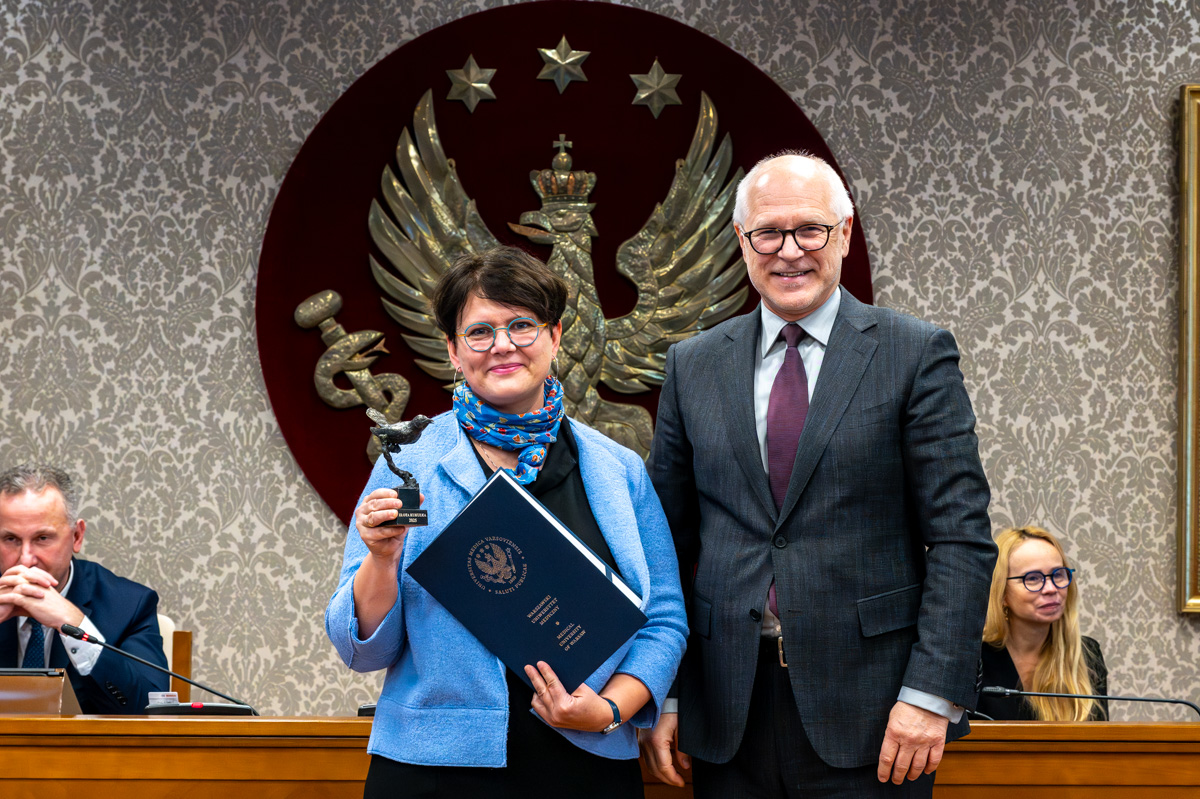
Titled “The Influence of Strontium on Bone Tissue Metabolism and Its Application in Osteoporosis Treatment”, her paper has been cited 154 times (citation statistics according to the Web of Science database). It was published in 2021 in the International Journal of Molecular Sciences (points assigned by the Polish Ministry of Science and Higher Education: 140; Impact Factor: 4.9). The paper was co-authored with Barbara Kołodziejska, PhD, and Natalia Stępień, a student of medical analytics at the WUM Faculty of Pharmacy.
Why the Topic Matters
The goal of the paper was to present the current state of knowledge on strontium, an element with chemical properties similar to calcium, and to identify the directions for future research, which could help develop safer and more efficient methods to treat osteoporosis.
So far, research results have demonstrated that strontium works in two ways. It stimulates osteoblasts, i.e. bone-building cells, while also inhibiting the activity of osteoclasts, which are responsible for bone resorption.
“For modern medicine, osteoporosis remains one of the major health challenges, as it leads to progressive bone tissue loss and increased risk of fractures. That is why it is worth exploring new therapeutic opportunities,” explains Professor Joanna Kolmas. “In the paper, we presented the ways in which strontium may contribute to regenerating bone structure and improving its resilience, and how it may have a positive impact on the balance between bone formation and bone resorption.
The authors also discussed matters such as the key signal pathways likely regulated by strontium ions, reviewed the previous clinical experiments involving the use of strontium ranelate, and analyzed the limitations involved when using this element in systemic therapy.
“Interest in using new forms of strontium ions has been growing, especially with respect to biomaterials and medical implants, where it may facilitate local bone regeneration with minimal adverse effects,” says Professor Kolmas.
About the “Golden Cuckoo” Award
The “Golden Cuckoo” is awarded in a competition. To be considered, a paper must include affiliation to the University and must have been cited at least 50 times (self-citations excluded) over the period of five years preceding the application. The prototype of the statuette was made by Jarosław Madeja, a sculptor. Its golden color is due to the type of bronze used.