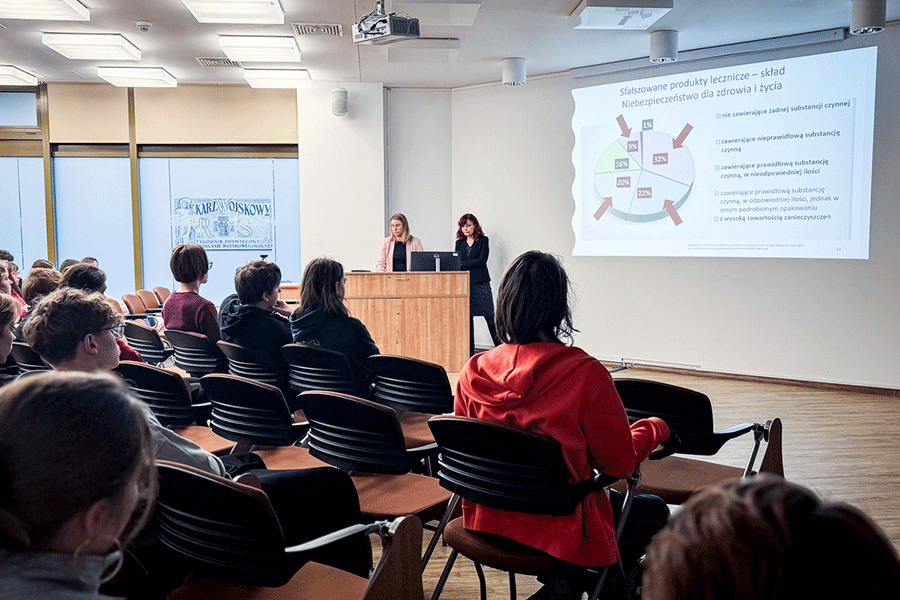
The scale of the problem, the ways to identify counterfeit medicines, and the reasons they are dangerous were discussed by Małgorzata Kubacka, PharmD and LLD, from the Department of Applied Pharmacy, and Agnieszka Kalicka, MSc, from the Department of Medicinal Chemistry, Pharmaceutical and Biomedical Analysis.
The guests of the meeting were students from Władysław IV High School and Stefan Żeromski High School, who are participating in the new edition of the Patronage Program.
Counterfeit medicinal products and the scale of the problem
According to the World Health Organization, counterfeit products account for 10 percent of the global medicines market, although this figure may be underestimated. Counterfeit products are most common in Africa and India. In Poland, they account for about 1 percent of the medicines market. However, just like in global data, the scale may be much larger, because many crimes remain undetected or unreported.
According to data from the Ministry of Health, the products most often counterfeited include anabolic agents (doping substances), weight loss products, and medicines used to treat erectile dysfunction. The reason is simple. They are in highest demand.
“The profit, which exceeds production costs many times over, is the key motivation for perpetrators of pharmaceutical crimes,” explained Agnieszka Kalicka. “The cost of producing counterfeit Viagra, a medicine used for erectile dysfunction, is only two zlotys. The same tablet is later sold online for about thirty zlotys.”
“Data from the Ministry of Justice for the years 2008 to 2020 show that approximately seven million adults were convicted under all criminal provisions in force during that period. In contrast, only 1,040 people were convicted under laws related specifically to counterfeiting medicines intended for human use,” added Małgorzata Kubacka.
Why counterfeit medicines are dangerous
They are produced in conditions that lack any standards or Good Manufacturing Practice. Such products are also stored and transported improperly. To illustrate the problem, the presenters showed shocking photos of illegal production sites.
“In a legitimate pharmaceutical plant, the active substance is mixed with the excipient in specialized mixing machines. In illegal facilities, mixing is done in a regular concrete mixer, and sometimes in confectionery mixers,” said Agnieszka Kalicka.
This results in an uneven distribution of the active substance. Consequently, among the manufactured tablets there are some that contain none of it, which occurs in 32 percent of cases, and others that contain too much. Taking such medicines can cause serious harm to health. A particular danger is posed by products that contain high levels of impurities and mixtures of active substances from different therapeutic groups. These account for as much as 9 percent of illegally produced products. In addition, counterfeit products often contain inappropriate excipients such as gypsum.
“In the case of some anabolic androgenic steroids in injectable form, the solvent for the active substances is store-bought cooking oil,” said Agnieszka Kalicka.
How to recognize that a medicine is genuine
The presenters emphasized that medicinal products should be purchased exclusively in pharmacies and that buyers should avoid purchasing medicines online, at markets, or in illegal sports supplement shops.
“Estimates indicate that even 50 to 60 percent of medicines sold online are counterfeit. This primarily concerns steroids and other substances banned in sports,” emphasized Dr. Małgorzata Kubacka.
The speakers also noted that when purchasing medicines from pharmacy websites, it is important to check whether the footer includes the green “Legal Online Pharmacy” logo. Clicking on the logo redirects the user directly to the Register of Pharmacies operated by provincial pharmaceutical inspectorates. The fact that a pharmacy is included in the register confirms its legality and that it holds the appropriate authorization. Małgorzata Kubacka stressed, however, that buyers should always check whether the displayed register is located on a gov.pl domain. The absence of this domain may indicate that the page is only pretending to be the official register.
The presenters reminded the attendees that when purchasing medicines, it is important to check the packaging. It must include the name of the medicine, the name of the active substance, the amount of the active substance (strength or dose per tablet), the number of tablets or capsules, the name of the marketing authorization holder, the expiration date, the batch number, and the marketing authorization number. All of this information must be provided in Polish.
Since 2019, pharmaceutical companies have been additionally required to include two safety features on packaging. These include a seal that confirms the product has not been previously opened and a QR code containing the expiration date, batch number, and a unique identifier for the specific package.
At the end of the meeting, the presenters described their work in the Counterfeit Medicines Team, which has been operating at the Faculty of Pharmacy since 2017. The team conducts analytical testing and prepares expert opinions, thereby supporting law enforcement agencies in uncovering pharmaceutical crimes.