The anatomy of teaching
How did you become an anatomist, Professor?
I chose anatomy as my scientific field in order to be a better surgeon. At the very beginning of my journey, I did not know yet what surgical specialty I would choose, but I knew that I wanted to be good. And I thought that it would not work without anatomy. However, I started my career somewhat by accident – I managed to pass the anatomy exam on the first try, although it had been rather unexpected. I had three re-sit exams before a board, which means I did not pass two exams three times.
How is that possible?
It's really simple. I didn't know how to learn (laughs). Luckily, Dr Roman Chruścikowski, unfortunately already deceased, who was my examiner, focused on the topics from the re-sit exams. Somehow I managed to defend myself and got a three. And because I hadn't completely grown tired of anatomy, because I was interested in it and I was thinking about a surgical career, I decided: there are three review sessions for the exam in August, so I will be coming to the dissection lab. It soon turned out that I was one of the few people in this place who actually knew something. So I began helping my colleagues and that's how it started.
You said something important – that you didn’t know how to learn. How did you acquire this skill, then?
Indeed, I did not know how to learn. First of all, a first-year medical student faces a huge amount of information to memorize. And this is what you need to be able to sort out somehow. Some can do it better, others worse. I had a problem with it, I wanted to imagine everything, and it takes time. I didn't have enough of it. In secondary school, I was a student with an average of no more than three. It was because I mainly spent my time reading books, that's what I was interested in the most. When I made the decision to apply to medical school – and it was halfway through my secondary school – I just sat down to read books, not the secondary school books though, but all sorts of books. I read them all the time, several times each. For example, I remember an excellent biology book by Władysław Goldfinger, an outstanding Polish microbiologist – his general biology textbook was remarkable! I read it five or six times because it was so interesting. At the same time, as I read it again and again, I inevitably had to learn (laughs). And probably this is what I lacked during the first year of studies: to be able to read certain parts of the material many times.
So is rote learning what matters most in your field?
Well, it's not only rote learning, because if someone approaches it this way, they will learn a dictionary. But this dictionary is made up of terms that symbolize certain structures. These structures have a spatial context and all of this has to be imagined.
So how do you teach anatomy to your students?
Most often, I ask them to read the table of contents of the anatomy textbook at the beginning. The table of contents probably includes eighty percent of the terms that they need to know for the exam. This is, of course, a metaphor, but the basics are the most important. If someone organizes these basics, they can add further information to them. And if there is no framework on which to organize them, the student will keep wandering and searching.
But how to build this framework?
Well, we start by introducing a system of concepts that allow us to navigate the space of the human body. I mean the axes, planes, directions. There are three axes: vertical, transverse, and sagittal. Three planes and three pairs of directions. It adds up to twelve terms. Unfortunately, there are students who are unable to rationally master these twelve concepts by the end of the first year of study. That's where their problems stem from. They confuse axes with planes, even though movements occur around the axes. That makes another six concepts, as there are two movements around each axis. Then you have to add six to twelve. It makes eighteen concepts which constitute the most important foundation.
What comes next?
A movable structure is created. Information, which becomes knowledge through processing, allows us to explore the human body in our imagination. For example, I can imagine being in the left ventricle of the heart, going through the aortic valve, walking along the ascending aorta, climbing, then looking up the aortic arch, passing the openings of the aortic arch branches. And then – hop! I drop down along the aorta to the bifurcation, passing various branches along the way.
You are talking about a structure that needs to be imagined. It seems like an architect's job.
It really is a bit so. Then, there is movement, position, moving along an axis and so on. Without this system, it is later impossible to understand the imaging of the human body: tomography, resonance imaging or ultrasound. There are cross-sections, so you need to know what makes one cross-section different from the other, because depending on what cross-section it is, some things are visible and others are not. This is just the beginning. And everything else is a consequence.
In other words, a good anatomist creates a virtual reality in their mind, inside which they navigate?
Most people of my generation look at contemporary three-dimensional atlases with some skepticism. I don't need such an atlas, I actually have it in my mind. Looking back, of course, the question arises whether it is worth spending as much time as I did to create such an atlas in my mind.
So students, in order not to have problems with anatomy, need time, good memory and imagination?
This would be ideal, there is a lot of anatomical and histological information during the first year. But I have to admit that I feel sorry for the students today. How are they supposed to sort out all of this in their minds, when, for example, they are on shift at McDonald's in the evening and afterwards they need to hit the books? It's hardly surprising that the results might be unsatisfactory. My only responsibility during studies was to learn. I had no other duties. And it is really unfortunate that many students, instead of studying, have to work so much to make ends meet in Warsaw. The work I did in the following years of my studies, which I could undertake thanks to the kindness of the former head of the Department of Anatomy, only helped me develop. Then, at the same time, I went to the hospital to get a feel for medicine.
In addition to learning, do you also need an element of work?
For me, yes, but the work should be related to it. I never cared about any extraordinary grades. However, we had a deal with the head of the Department of Anatomy, that we should act appropriately. We couldn't fall behind, as we were teaching our younger colleagues. I have always believed that you need to develop yourself. That's why I spent a year in orthopedics at Solec. No one paid me for it then. I was a volunteer who came to work shifts. Eventually, I chose neurosurgery and spent a large part of my studies studying it, alongside anatomy. But those were completely different times.
It is said that the teacher should open the door and show us where to go, but you have to continue walking on your own. Is this a right way to grow?
The teacher's role is to present something engaging. If someone comes and says: “I would like to learn this or that”, you have to be open. You have to let this young person into your world. Then he comes, we invite, show, and give something. The thing is, that he wants more and more. Then comes the moment when you have to open that door and let the person out. Start off by going for calm waters. But let him fall into deep water, because without mistakes you cannot acquire skills. This is a difficult moment for the teacher and for the student. I realized this when I was a teacher myself at the operating table in a hospital.
What does such a shared journey toward opening the door look like?
At the operating table, he assists me first, I give him instructions. Then, he performs the subsequent steps himself until they add up to a complete treatment. In the next step, we switch roles – I assist, he operates. Then, he operates on his own, and I sit on the sidelines in the operating room. And then, the time comes when I have to step outside, sit in the next room, pick up a newspaper or a book and wait. And he stays in the operating room. And it's very stressful. But a person who learns surgery, as well as other fields, must have a space for independent decisions.
It's just like raising children, isn't it?
Of course! Time is all it takes, as I've already said. Such a person needs to grow up, he needs to be able to make some minor mistakes and understand their possible consequences, he needs to become mature. You need experience, practice, and get to know, as Winnie the Pooh put it, "little cake things with pink sugar icing", meaning the most common ways of doing things (laughs).
And do you see any benefits for yourself from teaching others?
It is absolutely true that teaching someone is highly conducive to self-learning. It is so, because you have to organize all that knowledge, sort through the information, and then express it in a way. This forces you to think about the material many times and consolidates knowledge. So there's no better way to learn than by teaching someone else.
Anatomy has helped you get to know the human body in great detail, but has it taught you anything about life?
It's a difficult question. It surely taught me that life is not endless. And sometimes I even say that there is no day that I do not start with the thought of death. In a way, that's true. It is something that always accompanies me in my work as an anatomist.
Has the way anatomy is taught changed over the years?
The attitude towards the student has certainly changed a lot compared to when I was studying. First of all, the way knowledge was tested was much more stressful than it is today. Oral exams were very often the occasions when students found out that they weren't good enough. During an oral exam, any mistake may be the starting point for a more in-depth question. I call it a "penetrating" question.
What would immediately disqualify a student during an oral exam?
If, during the oral exam, the student informed me that, for example, the aorta originated from the left atrium of the heart, that’s the kind of answer that would end the exam, regardless of what the person had said earlier and what he would like to say later. But today, if a student makes such a disqualifying mistake in one question, it is just one of a hundred and twenty questions. Because all exams are in a test form. So, if he answers correctly to one hundred and nineteen others, he may even get a very good grade.
In your class, can one get in trouble for not knowing the material?
That's different. If I ask questions in class or bring up a topic for discussion and someone responds, I try to say: “Oh, yes, you are right about that.” I don't say right away that something is wrong. My task is to direct the conversation in such a way that the student chooses the right path. Of course, sometimes you have to say “no”, because if someone says something ridiculous, you need to stop them immediately so that those who listen to him do not pick up the wrong ideas. But I always try not to belittle the person I'm talking to. The problem is that today's students are incredibly afraid.
Of what? Your criticism?
No, not even my criticism. They are afraid of looking foolish in front of their colleagues. They wihtdraw so as not to make fools of themselves. They live in these social media, where everyone immediately writes, comments, evaluates, points out. This limits them. It would be much better if they were not afraid. They should ask teachers questions, also difficult ones or ones that are not always clever, and they do it too rarely. I will not be offended by any question. After all, it is in my best interest to educate them as best as possible, because there is a risk that ten years from now they will be the ones treating me. So I'd rather be treated by well-educated physicians (laughs).
What advice would you give to new students?
Give yourself time, develop on your own and do not be afraid to make mistakes – you cannot gain skills without them. And if you really want to understand something, try explaining it to someone else.
Interview by Agnieszka Wlazłowska
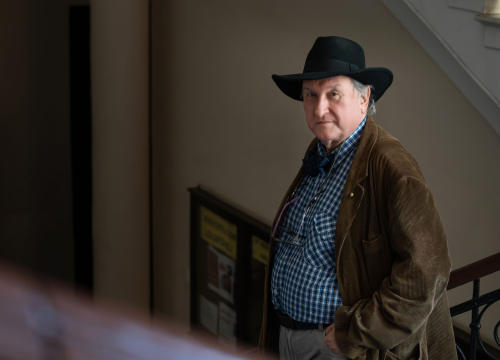
Photo by Michał Teperek
WUM Communication and Promotion Office