Advances in kidney transplants
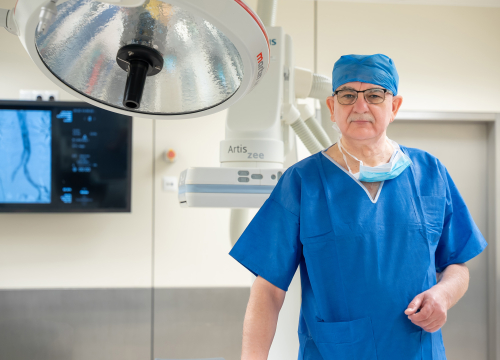
Your department continues the clinical and scientific achievements of the First Chair and Department of Surgery of the Medical Academy, headed by Prof. Jan Nielubowicz. The first successful kidney transplant in Poland was performed there. What was the significance of this procedure for Polish medicine?
Exactly 60 years ago, on January 26, 1966, a milestone was reached in what was then a new field, i.e., transplantology. Previously, no one in Poland had transplanted any organ. The team that accomplished this consisted of two great professors: Prof. Jan Nielubowicz, a surgeon and visionary of Polish medicine, and Prof. Tadeusz Orłowski, an internist and a nephrologist. Those two doctors made history by performing a kidney transplant in an 18-year-old nursing school student. The transplant was successful and the kidney began functioning while the patient was still on the operating table. It is worth noting that no more than 400 kidneys were transplanted worldwide at that time. This means that we were very close to world-class medicine. The event paved the way for the development of transplantology in Poland.
It was not the first attempt to transplant a kidney in Poland. However, it was the first successful one. What determined the success of the operation performed under the supervision of Prof. Nielubowicz?
The perfect preparation of the team was of key importance. Previously, Prof. Jan Nielubowicz had been on scholarship at a very famous medical center in Boston (the United States), where kidney transplants had already been performed. The professor's assistants were also trained there. This resulted in the creation of a very competent team of surgeons. On the other hand, Prof. Tadeusz Orłowski was responsible for creating the internal medicine team that cared for the patient after the operation.
Harvesting an organ also constituted a much greater challenge than it is today. Why?
The problem was that there were no legal regulations for organ harvesting and transplantation at that time. Therefore, the fact that the organ was harvested was the result of an agreement between people of good will. The consent for harvesting an organ had to be granted by the prosecutor and he did so understanding that this could save someone's life. The donor died as a result of a road traffic accident. It is worth noting that in those days kidneys were harvested only after circulatory arrest. Therefore, it was necessary to synchronize harvesting and transplantation. The recipient had to come to the hospital earlier. Then, she was waiting for surgery when the surgeons harvested the organ. The idea was to limit the period of ischemia: from the moment the kidney ceases to function in the donor's body until it is placed in the recipient's body.
After the first successful kidney transplantation in Poland, in 1988, the specialists of the 1st Chair and Department and Surgery also performed the first simultaneous pancreas-kidney transplantation in Poland. What is the history of this procedure?
The operation was performed by Prof. Jacek Szmidt. He headed the department for 16 years and it is currently headed by me. The procedure was performed in a woman with type 1 diabetes. The patient developed diabetes in her youth, and years later she developed end-stage renal disease. Thanks to the simultaneous pancreas-kidney transplantation, the woman no longer required either dialysis or insulin treatment. She was free of diabetes and lived for almost 25 more years. She died of cardiac causes. The pancreas and kidney worked very well.
Why was it so important to transplant the pancreas and kidney at the same time?
Diabetes mellitus, specifically diabetic nephropathy, is one of the causes of end-stage renal disease. When insulin was discovered more than 100 years ago, it seemed to be an absolute breakthrough and it was thought there would be no more complications of diabetes. Meanwhile, it turned out that this was not exactly the case. At the moment, the prevalence of diabetes has reached pandemic proportions. Almost 200 million people suffer from it worldwide. In some people, the disease leads to kidney function impairment – these people require dialysis. If we compare the quality of the life of dialysis patients and post-transplantation ones – these are two different worlds. Scientific research shows that a patient who has had a kidney transplant lives twice as long as one who undergoes dialysis. Not to mention the so-called machine-dependency syndrome – dialysis can be performed up to three times a week and last for four hours. Kidney transplant frees patients from such dependencies. After transplantation, in addition to the daily use of immunosuppressive drugs, the patient can work, travel, enjoy life. Humanity has not come up with a better method of replacing kidney function than transplantation. I would also like to mention children who have end-stage renal disease. For them, transplantation means proper development, the ability to attend school and independence from dialysis. It is a really big deal.
Now let's move on to the department you head. How many kidney transplant procedures do you perform in a year?
The number varies. We perform about 90 kidney transplants per year. However, there was a time when we performed even 180 procedures per year. If we look at the proportion, then out of over 31,000 kidney transplants performed so far in Poland, our department performed almost 3,000, i.e., 10%. This means that we have a really huge experience. And why are we transplanting fewer organs now? – because we currently have 20 transplant centers in Poland. We transplanted more when we were one of the few.
What is the "standard" course of kidney transplant procedure and how long does it take?
It all depends on how the recipient has been qualified, i.e. what comorbidities they have. The presence of significant atherosclerotic lesions is key information in the case of end-stage renal disease. As I mentioned, diabetes leads to kidney failure. It also causes hardening of the vessels and the aggravation of atherosclerotic lesions. It is a serious clinical problem, especially in recipients over 50 years of age.
However, if we have a patient free of comorbidities, a kidney transplant procedure takes 2-3 hours. We try to educate new surgeons at the department and they learn transplants under our supervision. I was lucky enough to perform my first kidney transplant at the age of 26. I was offered such a chance because for many years as a student I was the head of the surgical club in the department of Prof. Nielubowicz and, of course, I was very interested in this area of medicine. After this operation, when I left the hospital, I was filled with great pride. The procedure was successful, and the recipient was in a very good condition and could be discharged with normal kidney function after two weeks. This is the "magic" of transplantology.
Is this the patient you remember best, or are there any other patients who have particularly stuck in your memory?
I have a dozen or so patients who underwent transplantation many years ago. In case of one person it is even 26 years and creatinine levels are still normal. The patients live very active lives. They want to prove that you can play sports professionally after transplantation. They even established the Polish Sports Association after Transplantation. They are proof that after transplant you can really do a lot and achieve a lot. Together with these people, we take part in the "Run for a new life", which promotes the idea of transplantation. There is no greater reward for a doctor than to see a patient he once operated on in such great shape.
You mentioned patients who survive many years after transplantation. What are the statistics concerning survival rates after kidney transplantation?
The results of kidney transplants in Poland are really excellent, slightly better than in Europe. 96% of the recipients survive one year with an active kidney and over 85% survive five years. Someone may ask: "Why do we have such good results in Poland?" This is due to experience and cooperation. The combination of surgical art with the skills of nephrologists and transplantologists yields such positive results. In general, success in medicine is related to teamwork.
The department you head is renowned for its innovation. What unique procedures have been performed in the department in recent years?
We are a tertiary care center when it comes to vascular and endovascular surgery (minimally invasive, that is, keyhole procedures). This is an absolute revolution that has taken place in surgery. In this way, we treat numerous conditions, such as aortic aneurysms or atherosclerotic lesions in the arteries of the lower limbs. We can perform an autotransplant, that is, we can remove the diseased kidney, repair and reimplant it. In addition, the department has an enormous track record in endocrine surgery. We are the reference center when it comes to the treatment of thyroid, parathyroid and adrenal diseases. In the case of endocrine surgery, most of the procedures are also performed with a minimally invasive approach. Furthermore, in cooperation with the Department of General, Transplantation and Liver Surgery at MUW, our department carries out a program of simultaneous liver and kidney transplantation. On the other hand, with the Department of Heart, Chest and Transplant Surgery – we transplant the heart and kidney at the same time. This is already the highest level of difficulty, but the results are very promising.
The department also performed a unique operation of simultaneous transplantation of both kidneys (en-bloc) to an adult recipient. What did the procedure involve?
It was the first procedure of this kind in our department. Less than half a year ago, we received an offer to harvest and transplant kidneys from a pediatric donor, because it was not possible to find a recipient for him at the Children's Memorial Health Institute. Such a procedure is more difficult than a typical transplant because the kidneys of a child are much smaller than those of an adult. We must also think about the fact that the kidneys will grow. In such a case, it was necessary to perform vascular microfusion and properly position both kidneys on the same wing of ilium.
The department you head is the only one in Poland where transplants are performed even in patients with advanced atherosclerotic lesions. Why is it possible?
We are fortunate to be both vascular and transplant surgeons. Therefore, we can cope in the most difficult cases, i.e., when a patient who needs a kidney transplant has advanced atherosclerotic lesions. It is not uncommon for an endovascular procedure to restore vascular patency before transplantation. We can also safely treat patients with vascular complications that may occur after kidney transplant. The most common of these complications include renal artery stenosis or the development of aortic aneurysm.
In the department, you consult and admit patients with the most difficult diseases from all over Poland, don't you?
Yes, this is possible thanks to our experience. We are very kind to departments that call us with a request for support in the treatment of such difficult patients. We often jointly determine the tactics of the management in order to help the patient as effectively as possible.
What are the biggest challenges in transplantology today?
Insufficient organ donation rates – this is the biggest problem. We have more patients waiting for a transplant than the number of deceased donors. Therefore, the promotion of kidney donation by family donors is a great opportunity. In Poland, we obtain no more than 5% of kidneys from family donors. However, in countries such as the Netherlands, the United Kingdom or the United States – the respective percentage is about 40, or even close to 50. It is an absolutely safe procedure. Obviously, it is a bit controversial, because we act against the principle of primum non nocere. We operate on a healthy person – because only such a person can be a kidney donor. Admittedly, this is one of the most stressful surgeries. Two extremely important things come into play here: that nothing happens to the donor during organ harvesting and that the kidney begins to function in the recipient's body.
In what direction will transplantology develop? Will these be new methods of obtaining organs for transplantation, or maybe improving immunosuppressive treatment?
Different directions are possible. For many years, people thought that it would be possible to perform xenotransplantations, i.e., transplantations of animal-derived organs. A pig is closest to us in terms of genetics. That is why attempts have been made to transplant a genetically modified pig kidney. Two such procedures were performed in the United States. However, maybe it will not be xenotransplantation at all? Maybe growing your own organs will be the future of transplantology? It is also important that we get to know our immune system even better, so that immunosuppressive treatment is more sublime or not necessary at all.
Interview by Iwona Kołakowska
Photo by Michał Teperek
Communication and Promotion Office, MUW
Authors
Prof. Zbigniew Gałązka
Iwona Kołakowska
Affiliation
Department of General, Vascular, Endocrine and Transplant Surgery UCC MUW
Communication and Promotion Office
Topics
first kidney transplant
simultaneous pancreas-kidney transplantation
innovations in transplantology