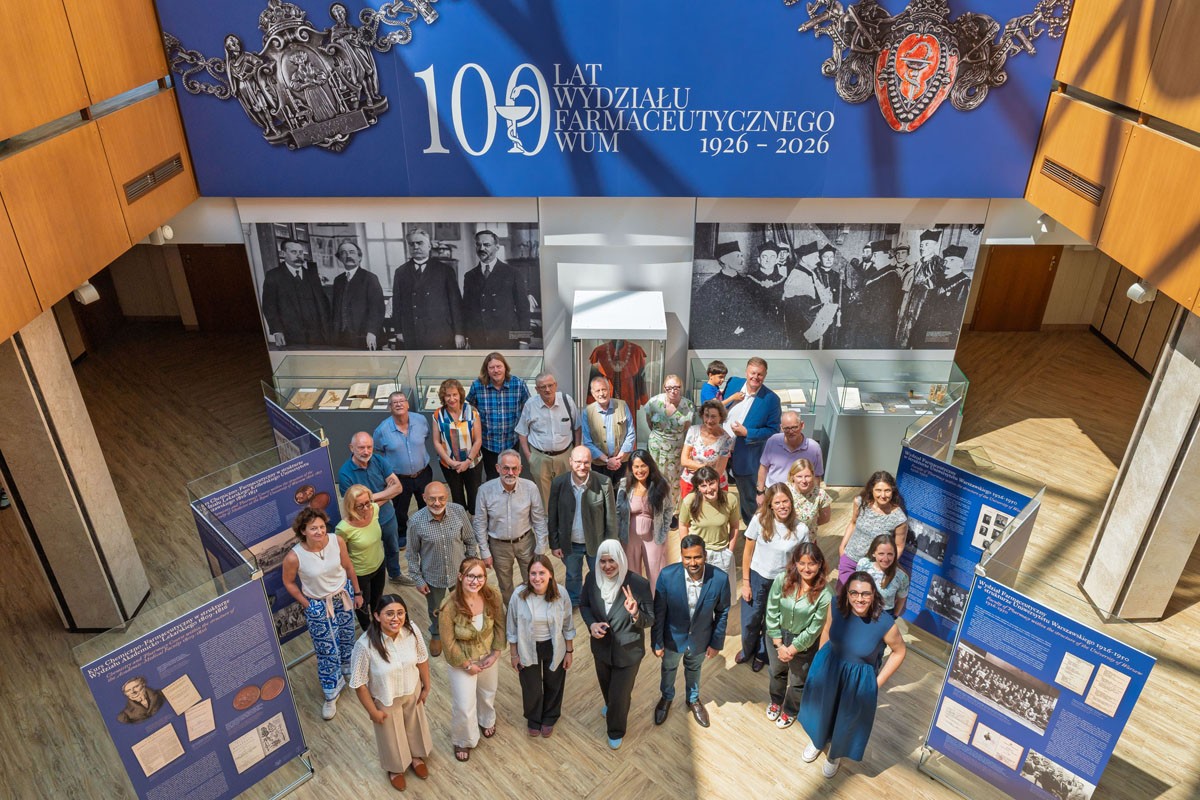
The project, more specifically, “Innovative Ligands for Nuclear Receptors to Eradicate Cancer Relapse,” is the Marie Skłodowska-Curie Doctoral Network funded by the European Union under the Horizon Europe program. Its aim is to develop new therapies to combat cancer recurrence and metastases caused by cancer stem cells.
Meeting in Warsaw
The PhD students come from Austria, Australia, Canada, Germany, Ireland, Israel, Italy, Poland, Spain, and the United Kingdom. They conduct research both at their home institutions and during international placements, making use of state-of-the-art infrastructure and the latest scientific advances. In their work, they test novel anticancer compounds that target nuclear receptors, particularly retinoic acid receptors (RAR) and the vitamin D receptor (VDR). Alongside their research, the young scientists acquire soft skills such as scientific communication, data management, and entrepreneurship.
They met in Warsaw to present their results findings completed so far and exchange ideas and experiences. Participants were welcomed by Prof. Andrzej Kutner from the Department of Medicinal Chemistry, Pharmaceutical and Biomedical Analysis, who is the leader of the project on behalf of WUM, and by the project coordinator, Dr. Martin Schepelmann from the Department of Pathophysiology and Allergy Research at the Medical University of Vienna.
The proceedings of PhD students, their supervisors and consultants began with lectures by Suzanne Turner, who explained mechanisms of drug resistance in childhood cancers, and Antonio Mouriño, who spoke about vitamin D and vitamin D receptor ligands.
What is WUM's objective in the project?
WUM’s responsibilities within the grant are particularly demanding and significant.
Our PhD student, Mayur Kadam, is developing new multistep synthetic methods for innovative hybrid compounds (designed by Dr. hab. Teresa Żołek from the Department of Organic and Physical Chemistry). The compounds he prepares will be sent to the team of PhD students who is responsible for the biological evaluation of the compounds. Based on the results of these studies, he will further optimize the molecular structures and continue subsequent stages of synthesis.
Mayur Kadam works under the supervision of Prof. Andrzej Kutner, Dr. hab. Teresa Żołek, and Dr. hab. Joanna Giebułtowicz from the Department of Medicinal Chemistry, Pharmaceutical and Biomedical Analysis.
“The participation in the consortium of as many as four Polish institutions, including three universities, serves as an acknowledgment of our country’s scientific potential in the field of research on new drugs with possible anticancer activity,” emphasized Prof. Kutner.
And he added:
“The PhD researchers involved in the eRaDicate project presented their findings at the international ACCORD 2026 conference. We are pleased that, among the seven young scientists awarded for the best presentations at the congress, three were PhD researchers from our project.”
Consortium Members, apart from WUM
In addition to WUM, the international eRaDicate consortium also includes: Medical University of Vienna, University of Wrocław, University of Birmingham, Ben-Gurion University of the Negev, University of Santiago de Compostela, TissueGnostics GmbH, University of Warsaw, Trinity College Dublin.
The consortium’s work is additionally supported by 13 partners.
The project will continue until 2027.